Look beyond Toyota's conventional cars and its patent drawings start to shrink mobility toward the person. A rider stands on a compact vehicle, a robot attaches to a joint, a powered wheelchair follows a companion, and even carts and lockers acquire their own movement.
The common thread is not simply autonomy. The machine changes itself around the person or the task: wheelbase changes with use, a seat changes shape around the body, and a delivery locker changes what can be seen after authentication.
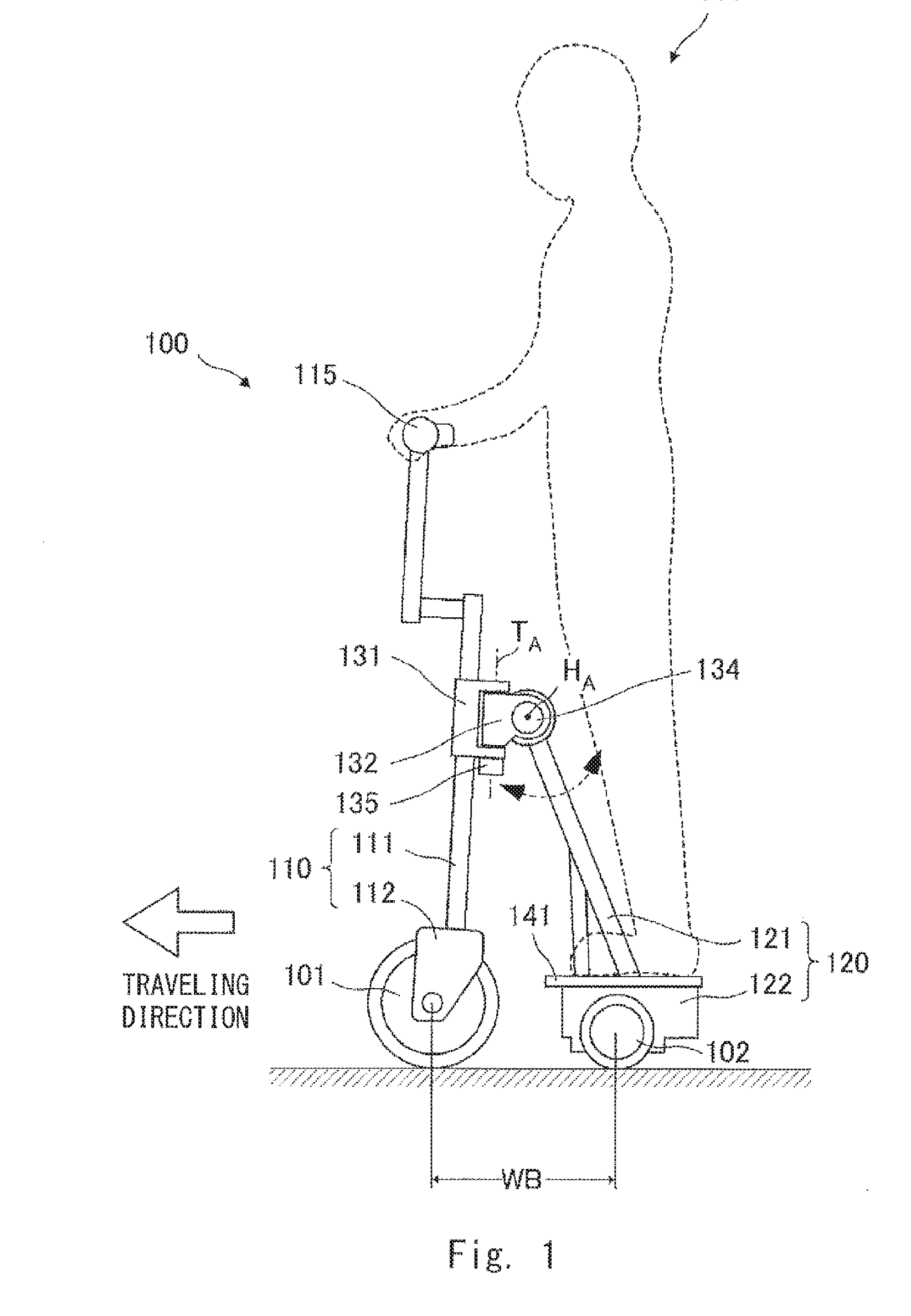
A one-person mobility device changes its wheelbase for maneuverability and stability
What is it?
Small personal mobility vehicles benefit from a short footprint in tight spaces, but higher speeds favor a longer, more stable wheelbase. This patent makes the distance itself adjustable.
Instead of choosing one fixed geometry, the vehicle can change the geometry that defines how it moves.
- ASSIGNEE
- Toyota Motor Corp
- PRIORITY
- 2016-09-07
- PUBLISHED
- 2018-03-08
- PUBLICATION
- US20180065701A1
- INVENTORS
- Takeshi Kama / Makoto Kakuchi / Makoto Mori
A second mechanical joint is worn directly on top of the human joint
What is it?
The system places a controllable robot joint alongside a human joint and uses torque to guide motion back toward an allowed range.
Here mobility is no longer something a person rides. The machine moves onto the body and participates in the act of walking itself.
- ASSIGNEE
- Toyota Motor Corp
- PRIORITY
- 2014-12-01
- PUBLISHED
- 2016-06-02
- PUBLICATION
- US20160151907A1
- INVENTORS
- Hikaru Sugata
The wheelchair follows a companion instead of waiting for joystick commands
What is it?
Instead of requiring continuous steering input, the wheelchair can build a profile of a companion and track that person's movement.
The navigation reference becomes another human being rather than only a destination or route.
- ASSIGNEE
- Toyota Motor North America Inc
- PRIORITY
- 2020-11-06
- PUBLISHED
- 2022-05-12
- PUBLICATION
- US20220142832A1
- INVENTORS
- Dario Jose Villarreal Suarez / Sarah Darrow / Douglas A. Moore / Christopher Lee
The scenery seen while moving can be replaced with another time or a virtual place
What is it?
The moving body carries a display visible to the passenger and synchronizes imagery with current position and direction. The patent describes showing past scenery, virtual overlays, or even interiors that the rider cannot physically enter.
Travel time becomes part of the experience rather than an empty interval between two places.
- ASSIGNEE
- Toyota Motor Corp
- PRIORITY
- 2018-10-30
- PUBLISHED
- 2020-04-30
- PUBLICATION
- US20200134922A1
- INVENTORS
- Takashi Kama / Yusuke Hara / Hiroshi Hiraiwa / Takahiro Shiga
The seat bolster grows around the passenger when lateral support is needed
What is it?
The seat can remain relatively flat during ordinary driving and activate embedded fluidic actuators when greater lateral support is useful.
Instead of choosing between a permanently tight sport seat and a comfortable flat seat, the seat changes its own shape.
- ASSIGNEE
- Toyota Motor Engineering & Manufacturing North America Inc
- PRIORITY
- 2019-01-30
- PUBLISHED
- 2020-07-30
- PUBLICATION
- US20200238854A1
- INVENTORS
- Umesh N. Gandhi / Brian J. Pinkelman / Ryohei Tsuruta
A robot rides on the vehicle hitch until it reaches the job site
What is it?
The system uses a vehicle hitch as the physical connection for carrying a robot to another location.
The vehicle handles long-range transport while the robot can perform work after arrival, linking two different mobility machines through one mechanical interface.
- ASSIGNEE
- Toyota Research Institute Inc
- PRIORITY
- 2018-01-26
- PUBLISHED
- 2019-08-01
- PUBLICATION
- US20190232992A1
- INVENTORS
- Joseph Bondaryk / Eric Krotkov
The self-driving part can detach from the cart and give another trolley mobility
What is it?
The trolley carries the objects while a traveling unit provides autonomous motion. The system can decide how that drive unit operates according to the amount of cargo.
Instead of building propulsion and sensing permanently into every cart, mobility itself becomes a reusable module.
- ASSIGNEE
- Toyota Motor Corp
- PRIORITY
- 2021-06-04
- PUBLISHED
- 2022-12-08
- PUBLICATION
- US20220390949A1
- INVENTORS
- Yoshihiro Shimada / Zixun Mei / Hiroyuki Kobayashi / Hideki Fukudome / Tomoko Asai
The delivery locker drives to the recipient and reveals only the correct compartment
What is it?
The autonomous body carries multiple independently lockable sections and travels to a location associated with the recipient.
The door window for the recipient's section remains opaque until authentication succeeds, then becomes transparent to reveal the correct item.
- ASSIGNEE
- Toyota Motor Corp
- PRIORITY
- 2023-02-28
- PUBLISHED
- 2024-08-29
- PUBLICATION
- US20240286468A1
- INVENTORS
- Masashi Nakamura / Masahiro Iwamoto / Takao Kataoka
AFTER THE FIGURES
Toyota looks different when the unit of mobility is no longer the car
Across these eight patents, Toyota treats mobility as something that can belong to a person, a joint, a wheelchair, a seat, a robot, a cart, or a locker. The four-wheeled vehicle becomes only one scale among many.
As the machines get smaller, they also get physically closer to the body. They support a joint, reshape a seat around an occupant, or follow the motion of a nearby companion.
For cargo, the same inversion appears in another form: instead of asking which vehicle should carry the object, Toyota gives the cart or locker a movable base of its own.
SOURCES
Primary sources
- US20180065701A1 — Traveling apparatus
- US20160151907A1 — Method for controlling wearable robot
- US20220142832A1 — Wheelchair systems and methods to follow a companion
- US20200134922A1 — Movable body
- US20200238854A1 — Vehicle seat with morphing bolsters
- US20190232992A1 — Hitch-mounted robot systems
- US20220390949A1 — Mobile body system
- US20240286468A1 — Autonomous mobile body