For a long time, the shape of a car has been organized around the act of driving: seats face forward, the steering wheel stays within reach, and displays face the person controlling the vehicle. Once automation and connected machines enter the picture, those arrangements stop looking permanent.
Across Ford patent drawings, the cabin becomes a lounge, theater, and workspace. The tailgate becomes a tool, a drone launches from the vehicle, a delivery robot cooperates with a building, and the HUD begins projecting beyond the windshield. In some embodiments the vehicle itself becomes an actor that can move without waiting for its owner.
These ten US patent publications explore how a vehicle can change roles. Ford sells an F-150 Interior Work Surface for a related purpose, but no one-to-one link to the desk patent discussed here was verified.
When the car drives itself, the front seats turn around to face the rear
What is it?
The patent describes front seats that can rotate to a rear-facing orientation or fold and move toward space beneath the instrument panel during autonomous operation. The center console can also move so occupants in the front and second rows can use it like a shared table.
If the person who would normally drive no longer has to face forward continuously, a one-direction seating layout is no longer mandatory. Facing each other changes how the occupants can talk during the trip.
- ASSIGNEE
- Ford Global Technologies LLC
- PRIORITY
- 2013-11-20
- PUBLISHED
- 2015-05-21
- PUBLICATION
- US20150142273A1
- INVENTORS
- Mark A. Cuddihy / Manoharprasad K. Rao
A large theater screen appears only while the vehicle is driving autonomously
What is it?
In autonomous mode, the entertainment system can present media on a larger screen using a projector. When the vehicle needs to return to non-autonomous operation, the system can move the media presentation to another display and clear the driving view.
The system changes which display is active according to whether the occupant is driving or spending the trip doing something else.
- ASSIGNEE
- Ford Global Technologies LLC
- PRIORITY
- 2013-09-30
- PUBLISHED
- 2015-04-02
- PUBLICATION
- US20150094896A1
- INVENTORS
- Mark A. Cuddihy / Manoharprasad K. Rao
A work desk rolls out of the dashboard
What is it?
The desk is built from linked panels whose support arms follow tracks in the dashboard. In storage the panels conform to the trim; when deployed they move rearward and form a substantially flat work surface in front of the occupant.
Ford also offers an Interior Work Surface on the F-150. No direct patent-to-product lineage between that feature and this publication has been verified.
- ASSIGNEE
- Ford Global Technologies LLC
- PRIORITY
- 2022-07-25
- PUBLISHED
- 2024-01-25
- PUBLICATION
- US20240025322A1
- INVENTORS
- Stuart C. Salter / David Brian Glickman / Dustin Shedlarski / Micah Jones / Ryan Welch
Open the tailgate and a folding work support comes out of the truck
What is it?
The patent places a folding sawhorse inside a recess in the pickup tailgate. Its legs can be stowed inside the structure and opened when the support is removed for use.
Part of the vehicle body becomes the storage location for a work tool, extending the idea of a mobile workspace beyond the cabin.
- ASSIGNEE
- Ford Global Technologies LLC
- PRIORITY
- 2016-09-15
- PUBLISHED
- 2018-03-15
- PUBLICATION
- US20180072242A1
- INVENTORS
- Brian Robert Spahn / Pattrick Loew
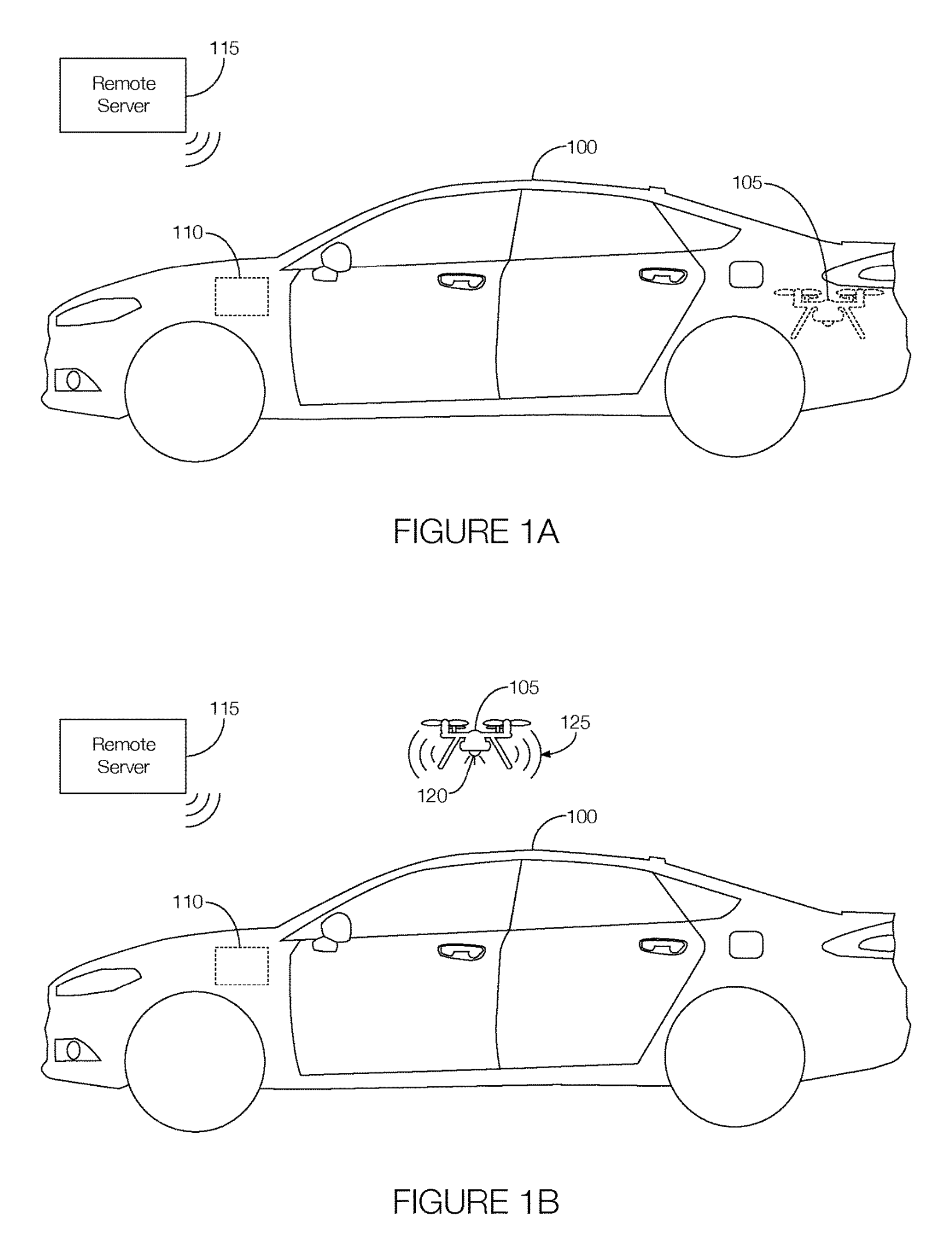
A drone launches from the car and becomes a flying light, siren, and lookout
What is it?
After an alert signal, the vehicle can open the storage area and release a drone secured inside. The drone can fly above or follow the host vehicle, shine a light, sound a siren, or operate in monitoring and security modes.
Rather than treating the drone as separate equipment, the patent makes it an extension of the vehicle's sensing and warning system: an eye and signal source that can leave the body of the car.
- ASSIGNEE
- Ford Global Technologies LLC
- PRIORITY
- 2016-07-07
- PUBLISHED
- 2019-10-10
- PUBLICATION
- US20190313228A1
- INVENTORS
- Francisco Javier Ferreira / Gerardo Velazquez Monroy / Joan Manuel Hernandez / Erick Garcia Dominguez
When the delivery robot gets stuck, the house camera helps it find the door
What is it?
After a delivery robot reaches a property, it can receive images from the building's security system and use landmarks in those images to navigate to the designated package drop-off spot. Authentication can also be used to open a gate or door.
The delivery vehicle, the small robot, and the destination building cooperate to solve the last stretch of the route.
- ASSIGNEE
- Ford Global Technologies LLC
- PRIORITY
- 2020-10-12
- PUBLISHED
- 2022-04-14
- PUBLICATION
- US20220113731A1
- INVENTORS
- Kenneth Yesh / Justin Miller / Shankar Mohan
One button turns the cabin into a pet-oriented room
What is it?
Selecting a dedicated pet mode can cause the vehicle computer to coordinate multiple systems: windows or the sunroof may open, a liftgate may move, rear seats may fold, and climate settings may change. The disclosure also describes sensing whether a pet is inside.
Instead of assigning one button to one component, the patent bundles a group of physical and environmental changes into a mode for a different kind of occupant.
- ASSIGNEE
- Ford Global Technologies LLC
- PRIORITY
- 2018-10-25
- PUBLISHED
- 2020-04-30
- PUBLICATION
- US20200130702A1
- INVENTORS
- Francisco Ferreira / Luis Flores Alonso / Itzel Garrido / Luis Becerril
The HUD stops projecting only onto the windshield and throws an image outside
What is it?
The system uses a projector associated with a head-up display to project light beyond the vehicle. It can detect a wall, ceiling, or another vehicle surface and adjust projection angle, brightness, or other parameters so the image remains visible.
A device that normally communicates only with the driver becomes a way for the vehicle to signal people or machines outside. The disclosure even contemplates multiple vehicles coordinating their projected patterns.
- ASSIGNEE
- Ford Global Technologies LLC
- PRIORITY
- 2023-05-30
- PUBLISHED
- 2024-12-05
- PUBLICATION
- US20240399860A1
- INVENTORS
- Brendan Francis Diamond / John Robert Van Wiemeersch / Ryan Joseph Gorski / Haibo Zhao / Janice Lisa Tardiff
If payments remain delinquent, an autonomous vehicle can drive itself to a repossession location
What is it?
The patent describes a multi-step process in which unacknowledged delinquency notices can be followed by restrictions on selected vehicle functions and eventually a lockout condition. One illustrated scenario shows the vehicle parked inside a closed garage in an attempt to impede repossession.
For an autonomous vehicle, the disclosure also describes cooperation between the repossession computer and vehicle computer so the vehicle can travel to a repossession agency, lender, impound location, or other designated site without being driven there by its owner.
- ASSIGNEE
- Ford Global Technologies LLC
- PRIORITY
- 2021-08-20
- PUBLISHED
- 2023-02-23
- PUBLICATION
- US20230055958A1
- INVENTORS
- Anthony Maraldo / Brendan Diamond / Keith Weston / Michael Alan McNees
If nobody needs to steer, the steering-wheel rim itself tilts out of the way
What is it?
The steering-wheel rim is supported so it can pivot relative to the hub between a steering position and one or more non-steering positions. Locking devices hold the selected position, with embodiments using a cable and motor to release the mechanism.
During automated travel or while stopped, a large circular control directly in front of the occupant can become unused space. The patent treats even the iconic steering wheel as something whose shape can change with the mode.
- ASSIGNEE
- Ford Global Technologies LLC
- PRIORITY
- 2020-09-10
- PUBLISHED
- 2022-03-10
- PUBLICATION
- US20220073123A1
- INVENTORS
- Martin Fassbender / Philipp Kuepper / Klemens Degle / Bruno Alves / Thomas Kreuz
AFTER THE FIGURES
A box designed around the driver becomes a machine that changes with the task
The first three patents transform the cabin. Seats face each other, a large screen appears, and a desk rolls out of the dashboard. If a person does not have to spend every moment facing the road, the interior can be designed around how that time is used instead of only around driving.
Then the boundary moves outside the cabin. A tailgate stores a work support, a drone leaves the vehicle, a delivery robot borrows information from a building, pet mode reconfigures the environment, and a HUD projector sends information onto surfaces outside the vehicle.
The last two ideas change the relationship between person and machine even more sharply. A repossession system can restrict vehicle functions and, for an autonomous vehicle, direct it to a designated location. A steering-wheel rim can tilt away when it is not needed. Across the set, Ford repeatedly treats the vehicle not as one fixed object but as machinery whose role and shape can change with the situation.
SOURCES
Primary sources
- US20150142273A1 — Autonomous vehicle with reconfigurable seats
- US20150094896A1 — Autonomous vehicle entertainment system
- US20240025322A1 — Vehicle having deployable work desk
- US20180072242A1 — Vehicle tailgate with integrated sawhorse
- US20190313228A1 — Vehicle-integrated drone
- US20220113731A1 — Systems And Methods For Assisting A Delivery Robot
- US20200130702A1 — System and method for creating a pet-friendly automotive environment
- US20240399860A1 — Vehicle hud with external screen projection
- US20230055958A1 — Systems and Methods to Repossess a Vehicle
- US20220073123A1 — Tilting mechanism integrated in the steering wheel rim