Living with a pet is a chain of small daily jobs: watch, listen, feed, play, walk, wash, and clean up. Across patent drawings, those jobs are repeatedly separated into pieces that a machine might take over.
The automation is not limited to physical chores. One invention tries to infer emotion from a dog's bark. A collar records activity and location. A remote device uses a treat to pull a pet's gaze toward a camera. A robotic hand scratches a dog while the owner is away. Eventually even the walk and the cleanup after a dog relieves itself become machine tasks.
The ten patents below are US publications. Only the PetSafe ball launcher is marked related because an official product from the patent assignee's company can be documented.
Turn a bark into a guess about how the dog feels
What is it?
The patent converts a dog's voice into electrical audio signals, extracts time-frequency characteristics, and compares them with reference patterns. The listed emotion categories include loneliness, frustration, aggressiveness, assertiveness, happiness, and wistfulness.
Instead of measuring where a dog is or how much it moves, the system tries to measure what the dog may be feeling. Interpretation that normally belongs to the owner is reframed as signal analysis.
- ASSIGNEE
- Takara Co Ltd / Index Corp
- PRIORITY
- 2001-08-06
- PUBLISHED
- 2003-12-04
- PUBLICATION
- US20030221630A1
- INVENTORS
- Matsumi Suzuki
Put location and activity logging directly on the collar
What is it?
The smart animal collar combines sensors, radios, and interactive components in a wearable system for monitoring an animal. The system can collect information about location, activity, environment, and interactions with connected devices.
Like a human smartwatch, it turns otherwise uneventful hours into a stream of data. Watching a pet becomes partly a matter of reading logs.
- ASSIGNEE
- Smart Tracking Technologies LLC
- PRIORITY
- 2016-09-07
- PUBLISHED
- 2021-04-29
- PUBLICATION
- US20210120787A1
- INVENTORS
- Joseph T. McKee / Michael A. Basone / Heberto J. Calves
Use a treat to make the pet look into the video-call camera
What is it?
A remote camera is not enough if the dog will not look at it. This device briefly presents a treat where the pet can see it, with the camera positioned to capture the pet as it gazes toward the treat.
The engineering problem is attracting the animal's attention. A video-call interface designed for an animal replaces buttons and eye-contact instructions with food.
- ASSIGNEE
- Individual
- PRIORITY
- 2018-06-18
- PUBLISHED
- 2019-12-19
- PUBLICATION
- US20190380303A1
- INVENTORS
- Andrew Peter Davis
Let a robotic hand scratch the dog while the owner is away
What is it?
A camera and motion sensor identify an approaching dog. A treat dispenser can position the dog, after which a multi-joint arm and finger assembly performs the scratching motion.
The patent also contemplates microphones, speakers, and remote smartphone interaction. Remote pet care moves from seeing and speaking to physical touch.
- ASSIGNEE
- Individual
- PRIORITY
- 2020-07-04
- PUBLISHED
- 2022-01-06
- PUBLICATION
- US20220000071A1
- INVENTORS
- Cassidy Matwiyoff / Alexander Matthew Lopez / Daniel Sousa Jr. / Nicholas Ganson Repanich / David G. Alexander / Nicholas Chenevey / Marco Antonio Machuca-Romera / John Chen Danley / Luis Alberto Arevalo
Meter food with a conveyor belt and measure what gets eaten
What is it?
Rather than pushing kibble through a crowded outlet with a rotating blade, this feeder carries food upward on a toothed belt and drops controlled portions into the bowl.
The patent also describes bowl-weight sensing, a camera, wireless control, microphone, and speaker. A scheduled feeder becomes a system that can observe feeding behavior as well.
- ASSIGNEE
- Individual
- PRIORITY
- 2017-09-06
- PUBLISHED
- 2021-01-28
- PUBLICATION
- US20210022317A1
- INVENTORS
- Zilong Ling
When the dog returns the ball, the machine throws it again
What is it?
The launcher is designed around a dog learning to place a retrieved ball into a funnel. Once the ball reaches the launch point, an internal hammer mechanism fires it through the chute.
The machine removes just one side of fetch: the human throw. Once the dog learns the loop, play can continue without a person repeatedly launching the ball.
- ASSIGNEE
- Radio Systems Corp
- PRIORITY
- 2014-12-06
- PUBLISHED
- 2016-06-09
- PUBLICATION
- US20160161208A1
- INVENTORS
- Eric A. Ward
Hand the leash to an autonomous vehicle and let the dog go for a walk
What is it?
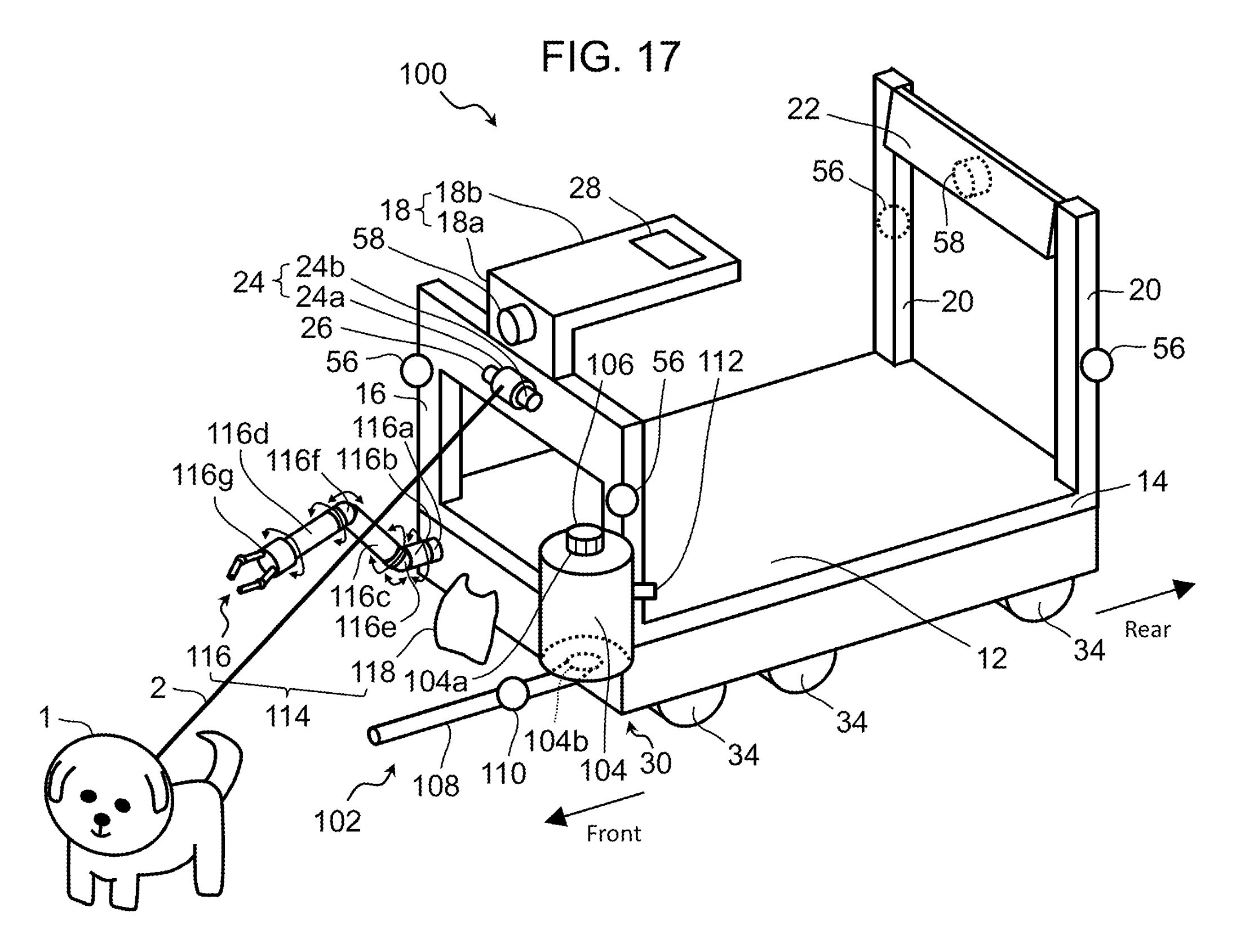
Toyota describes an automatically traveling guidance vehicle that keeps an appropriate distance from a leashed dog while following a walk route. The specification explicitly includes a walk-agency service without the owner accompanying the dog.
In the FIG. 17 embodiment, a water tank and hose can rinse urine, while an articulated collection arm can pick up feces and place it in a bag. The system targets the complete walk, not merely leash control.
- ASSIGNEE
- Toyota Motor Corp
- PRIORITY
- 2020-10-02
- PUBLISHED
- 2022-04-07
- PUBLICATION
- US20220104457A1
- INVENTORS
- Saki Narita / Tetsuya Kanata / Yozo Iwami / Daisaku Honda / Yuhei Katsumata / Hideki Fukudome / Takuya Watabe / Naoko Ichikawa / Yuta Maniwa / Yuki Nishikawa / Daisuke Ishii / Daisuke Sato
Move brushes along both sides of the dog and automate the wash
What is it?
The washing tub is flanked by movable brush plates driven by mechanical linkages and motors. Water is sprayed while the brushes move along the animal.
The key step beyond automated rinsing is mechanizing the rubbing action normally performed by human hands.
- ASSIGNEE
- Individual
- PRIORITY
- 2016-01-22
- PUBLISHED
- 2018-07-26
- PUBLICATION
- US20180206449A1
- INVENTORS
- Weijian Zhang
After the cat leaves, rotate the litter box and sift it automatically
What is it?
The cylindrical basin rotates about an axis. As it turns, an internal screen sifts litter from waste and directs the separated material into a rear container.
A motion sensor can be used so automatic rotation begins only after the animal is no longer inside. Daily scooping becomes a controlled rotation cycle.
- ASSIGNEE
- Individual
- PRIORITY
- 2017-10-20
- PUBLISHED
- 2019-06-06
- PUBLICATION
- US20190166789A1
- INVENTORS
- Bruce Keith Turner
Let the house decide which pet is allowed through the door
What is it?
A pet-specific key lets the door distinguish individual animals. Access can be allowed or denied by pet, direction, or time period.
The automated task is permission: the boundary of the house itself recognizes the animal.
- ASSIGNEE
- Individual
- PRIORITY
- 2005-03-21
- PUBLISHED
- 2012-10-25
- PUBLICATION
- US20120266540A1
- INVENTORS
- Crosby S. Noyes
AFTER THE FIGURES
The changing boundary of the owner's role
These patents break the relationship itself down into machine functions: interpret, monitor, talk, touch, play, feed, walk, wash, clean, and control access.
Toyota's guidance vehicle makes that shift especially visible. It can lead a dog along a route, and one embodiment adds water for urine and an articulated arm for collecting feces. The invention is no longer improving a leash; it is targeting the role of the person holding it.
Other inventions, such as bark interpretation and camera-gaze devices, are less about removing people than extending interaction into the hours when people are absent. Pet technology may automate care while simultaneously trying to preserve a sense of presence.
SOURCES
Primary sources
- US20030221630A1 — Apparatus for determining dog's emotions by vocal analysis of barking sounds and method for the same
- US20210120787A1 — Smart animal collar system
- US20190380303A1 — Device and method for directing a pet's gaze during video calling
- US20220000071A1 — Automatic dog back scratcher system and method of using same
- US20210022317A1 — Automatic pet feeder
- US20160161208A1 — Automatic Ball Launcher
- US20220104457A1 — Guidance vehicle
- US20180206449A1 — Automatic dog washing machine
- US20190166789A1 — Self-Cleaning Litter Box
- US20120266540A1 — Automatic pet door