An appliance is normally a tool a person operates. Follow Panasonic's patents, though, and the role of the machine starts to shift: from something people use to something that takes on part of the work beside them.
Wash hair. Stir a pot. Support a person lying in bed. Help someone stand and walk. Carry goods. Across ten drawings, the setting expands from intimate personal care to the kitchen, care facilities, hospitals, and finally the street.
Put your head down, and two arms wash your hair
What is it?
A user rests their head in the bowl while left and right washing units move around it. The units carry multiple contacts and nozzles for water and washing agents.
Independent left-right control is intended to wash effectively without imposing an unnecessary twisting force on the neck. A machine is taking over a very close-contact care task.
- ASSIGNEE
- Panasonic Intellectual Property Management Co Ltd
- PRIORITY
- 2010-08-18
- PUBLISHED
- 2013-06-13
- PUBLICATION
- US20130145540A1
- INVENTORS
- Osamu Mizuno / Soichiro Fujioka / Tohru Nakamura / Akinobu Okuda / Tsuyoshi Tojo
A robot arm stirs the pot after looking at the ingredients
What is it?
The system measures how high ingredients are piled across the cooking container, then changes the direction and position of the mixer.
The goal is to reduce uneven heating, burning, and damage to ingredients. Cooking is treated not as a fixed repeating motion but as a task that requires sensing the state of the pan and responding to it.
- ASSIGNEE
- Panasonic Corp
- PRIORITY
- 2007-10-10
- PUBLISHED
- 2009-04-16
- PUBLICATION
- US20090099691A1
- INVENTORS
- Tsuyoshi Tojo / Takanobu Tanimoto / Osamu Mizuno / Tohru Nakamura / Soichiro Fujioka
Slide the machine under a person and lift them while lying down
What is it?
Instead of asking a caregiver to lift a person from the bed, long supporting portions slide under the body and take the load.
The patent focuses on reducing physical burden on the caregiver while giving the person receiving care a greater sense of security. The machine enters the act of lifting itself, rather than merely becoming a cart afterward.
- ASSIGNEE
- Panasonic Corp
- PRIORITY
- 2006-09-20
- PUBLISHED
- 2008-03-20
- PUBLICATION
- US20080066228A1
- INVENTORS
- Yohei Kume / Soichiro Fujioka / Hirofumi Kawaguchi / Yoshihiko Matsukawa
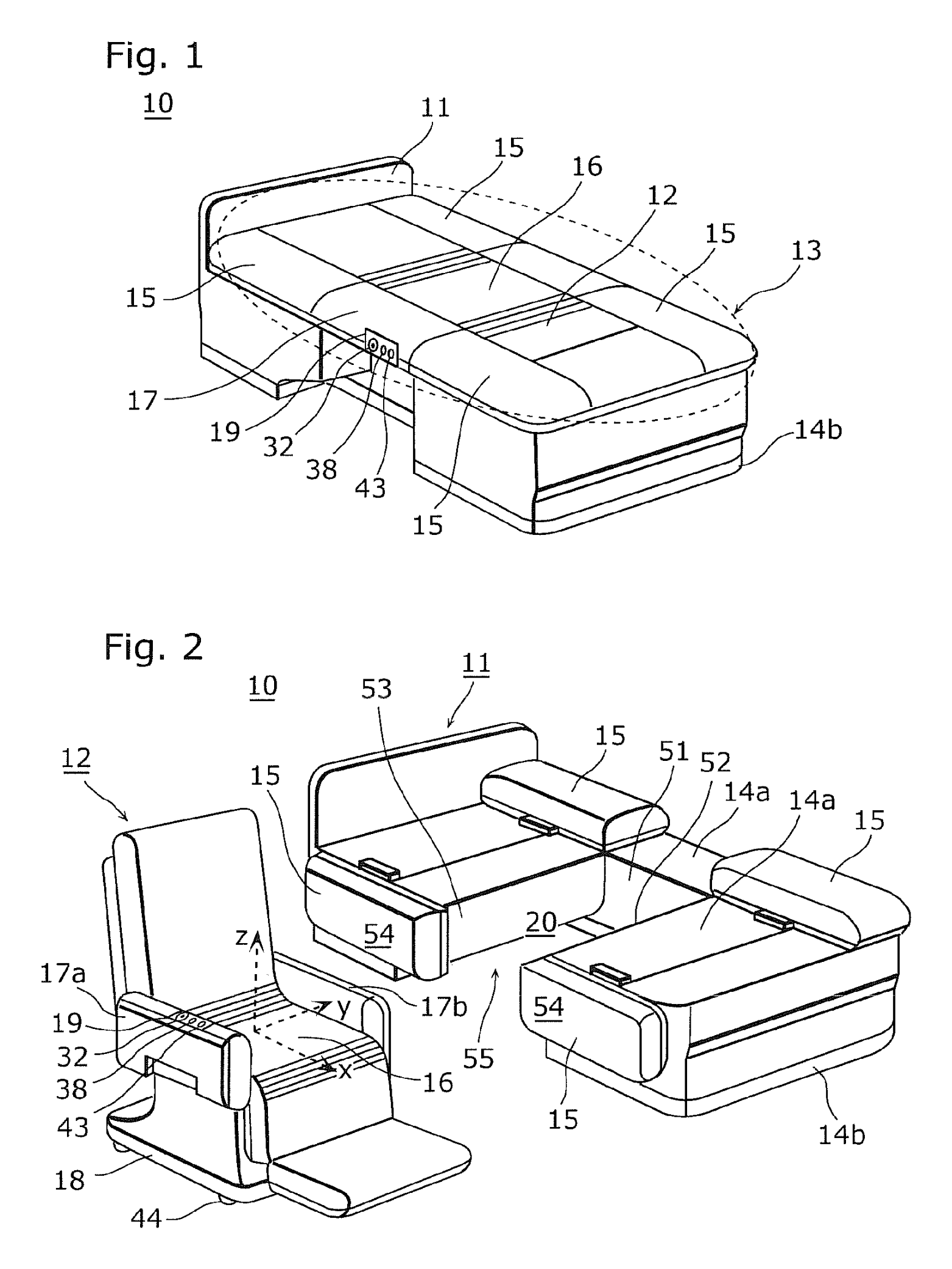
Part of the bed detaches and becomes the wheelchair
What is it?
The bed contains a stationary unit and a traveling vehicle. When combined, the traveling vehicle forms part of the bed; when separated, it can change posture and serve as a wheelchair.
Instead of improving the transfer from bed to wheelchair, the invention tries to remove the transfer. The place supporting the person becomes the vehicle.
- ASSIGNEE
- Panasonic Corp
- PRIORITY
- 2009-07-30
- PUBLISHED
- 2011-08-11
- PUBLICATION
- US20110196562A1
- INVENTORS
- Yohei Kume / Hideo Kawakami / Shohei Tsukada / Tohru Nakamura
A belt and robot shape the motion of standing up
What is it?
The system uses a care belt and robot to support a seated person through the process of standing.
The problem has shifted from simply adding lifting force to guiding a human motion. The machine is expected to follow how the body should move, rather than treating the user as cargo.
- ASSIGNEE
- Panasonic Intellectual Property Management Co Ltd
- PRIORITY
- 2014-09-19
- PUBLISHED
- 2017-05-11
- PUBLICATION
- US20170128293A1
- INVENTORS
- Yuko Tsusaka / Yudai Fudaba
A walking robot creates a safer space around its user
What is it?
The robot detects force on its handle while supporting the user's walking. The disclosure also describes projecting light onto the floor to show a boundary or warning when nearby obstacles are detected.
The safety problem now includes other people sharing the same space. The robot is designed not only to support its user but also to signal the space occupied by the human-and-robot pair.
- ASSIGNEE
- Panasonic Intellectual Property Management Co Ltd
- PRIORITY
- 2016-06-29
- PUBLISHED
- 2018-01-04
- PUBLICATION
- US20180000683A1
- INVENTORS
- Kazunori Yamada / Mayu Yokoya
Wear the machine and give your arms more working power
What is it?
Here the machine is no longer pushed or held: it is worn. Units arranged along the arms follow the wearer's motion and generate assisting force for heavy work.
Because heavy motors and frames can themselves become a burden, the suit is supported from above by a suspension member. The design has to assist the work without making the wearer carry the assistant.
- ASSIGNEE
- Panasonic Corp
- PRIORITY
- 2014-08-08
- PUBLISHED
- 2017-08-10
- PUBLICATION
- US20170225322A1
- INVENTORS
- Takuo Wariishi / Hiromichi Fujimoto / Makoto Konishi
The spherical robot does more than avoid you: it may come closer to talk
What is it?
The spherical body can roll through a room while using cameras, microphones, speakers, and face-like displays to interact with people.
When it encounters an obstacle, the controller does not always choose maximum avoidance. If the obstacle is the user, the robot may approach, invite conversation, or perform behavior intended to increase interaction.
- ASSIGNEE
- Panasonic Intellectual Property Management Co Ltd
- PRIORITY
- 2019-03-19
- PUBLISHED
- 2020-09-24
- PUBLICATION
- US20200298414A1
- INVENTORS
- Kento Ogawa
Predict where a person is going, then move around their future path
What is it?
Avoiding a person's current position is not enough when the person is moving. This patent uses temporal position changes to estimate a region where the person is likely to move next and treats that region as a virtual obstacle.
The disclosure contemplates nursing care, cleaning, conveyance, guidance, patrol, and other tasks. Sharing human space becomes a prediction problem, not just a mapping problem.
- ASSIGNEE
- Panasonic Corp
- PRIORITY
- 2007-04-12
- PUBLISHED
- 2009-02-12
- PUBLICATION
- US20090043440A1
- INVENTORS
- Yoshihiko Matsukawa / Soichiro Fujioka / Yuji Adachi / Toshio Inaji
Finally, autonomous robots bring services out into the neighborhood
What is it?
This patent coordinates multiple autonomous mobile robots and sends a selected robot to a location where a user wants a service. Each robot has a travel section and a box section used to provide the service.
The disclosure contemplates supplying goods such as drinks, lunch boxes, books, medicine, and ice cream, as well as services including guidance, signage, and security. The machine that began by taking over one task beside a person has expanded into something that moves through a community to bring the service itself.
- ASSIGNEE
- Panasonic Intellectual Property Management Co Ltd
- PRIORITY
- 2021-04-19
- PUBLISHED
- 2024-01-25
- PUBLICATION
- US20240028049A1
- INVENTORS
- Masayoshi Tojima / Shunsuke Kuhara
AFTER THE FIGURES
Beyond appliances were machines designed to work beside people
These ten inventions repeatedly break everyday work into smaller tasks and hand one of those tasks to a machine.
The sequence starts inches from a person's head, moves through cooking and physical care, becomes wearable, learns to share space with people, and ends outdoors carrying goods. The drawings preserve a wider Panasonic idea: electronics can move into the work of daily life itself.
SOURCES
Primary sources
- US20130145540A1 — Automatic hair washing apparatus
- US20090099691A1 — Cooking assistance robot and cooking assistance method
- US20080066228A1 — Supporting apparatus and nursing robot system
- US20110196562A1 — Traveling vehicle and bed
- US20170128293A1 — Standing-up motion assist system, control method for controller of standing-up motion assist system, storage medium, care belt, and robot
- US20180000683A1 — Robot and method of supporting walking using robot
- US20170225322A1 — Movement assistance device
- US20200298414A1 — Robot and control method of robot
- US20090043440A1 — Autonomous mobile device, and control device and program product for the autonomous mobile device
- US20240028049A1 — Information output method and information output device