Once a person falls asleep, there is not much left for that person to operate. Patent drawings therefore put the work into the objects around the sleeper. The pillow shifts the head. The bed rocks. Light passes through closed eyelids. Sound is cancelled before it reaches the person beside you.
The changes extend beyond beds to pillows, masks, bedding, bedrooms, and sleeping bags. Some intervene while you sleep, some reshape the environment around you, and one waits until morning to make the bed.
Eight Sleep currently sells a Pod system that adjusts temperature and uses biometric sensing, but we did not verify that the two-chamber enclosure in the patent discussed here maps directly to that product. It is marked only as related; the other eight remain unconfirmed.
The pillow hears a snore and shifts the sleeper's head
What is it?
Hong Jian Technology's patent places a snore detector and a motor-driven mobile seat inside the pillow. When snoring is detected, the mechanism shifts so that the sleeper's head changes from an upward position to an angled posture.
FIG. 5 shows the before-and-after head positions. Rather than asking the sleeper to roll over, the pillow changes position underneath the head.
- ASSIGNEE
- Hong Jian Tech Co Ltd
- PRIORITY
- 2007-10-08
- PUBLISHED
- 2009-04-09
- PUBLICATION
- US20090089932A1
- INVENTORS
- Fu-Ching Chen
Light therapy continues through closed eyelids
What is it?
Philips describes a sleep mask with lighting modules over both eyes. The disclosure focuses on a wavelength band of about 490–520 nm so that controlled light can pass through closed eyelids and influence sleep-cycle-related responses.
An ordinary sleep mask blocks outside light. This design blocks ambient light while deliberately adding a controlled light source on the inside.
- ASSIGNEE
- Koninklijke Philips NV
- PRIORITY
- 2010-05-14
- PUBLISHED
- 2013-03-07
- PUBLICATION
- US20130060306A1
- INVENTORS
- Michael Edward Colbauch
Two sleepers get two separate sleeping chambers
What is it?
Eight Sleep's patent includes a two-chamber sleep pod in which two people occupy separate enclosed spaces. The disclosure describes regulating environmental conditions, sleeping-surface position, sound, and other characteristics for the individual chambers.
Eight Sleep's current Pod 6 is a real product that independently heats or cools each side of a bed and uses biometric sensing, but it is not the two-chamber enclosure shown here. We have not verified a one-to-one patent-to-product implementation, so the current Pod is shown only as a related direction.
- ASSIGNEE
- Eight Sleep Inc
- PRIORITY
- 2018-01-19
- PUBLISHED
- 2020-12-31
- PUBLICATION
- US20200405998A1
- INVENTORS
- Matteo Franceschetti / Massimo Andreasi Bassi / Daipan Lee
Rock the entire bed, not just the mattress
What is it?
This rocking-bed patent mounts the mattress frame on a separate base and drives it with a motor and crank mechanism. FIG. 1 shows the version that pitches the sleeper's head and feet up and down.
The broader disclosure also covers roll, translational movement, vibration, and combinations of motion. Rather than vibrating a small insert, it turns the whole bed frame into the moving mechanism.
- ASSIGNEE
- Rock To Sleep Bed LLC / Rockin2sleep LLC
- PRIORITY
- 2021-09-20
- PUBLISHED
- 2023-08-17
- PUBLICATION
- US20230255360A1
- INVENTORS
- Radhakrishnan Srinivasan / Preetham K. Shivanna
A robot drives across the bed to make it
What is it?
The patent broadly combines sensing or vision, computing, and bedding manipulators so sheets and blankets can be lifted, pulled, and smoothed automatically. FIG. 3 shows an alternative embodiment in which a roving device moves across the bed surface.
The description goes as far as moving pillows out of the way, arranging the bedding layer by layer, smoothing it, and putting the pillows back. This invention works after sleep rather than during it.
- ASSIGNEE
- Individual
- PRIORITY
- 2003-03-05
- PUBLISHED
- 2004-10-28
- PUBLICATION
- US20040211006A1
- INVENTORS
- Stephen Dickerson
Detach part of the bed and it becomes the wheelchair
What is it?
Panasonic's patent builds a bed by combining a wheelchair with a bed main body. The wheelchair's segmented surface can flatten and connect with the rest of the bed to make a continuous sleeping surface.
Moving a care recipient from a bed to a wheelchair is physically demanding. This approach changes the object under the person instead: part of the sleeping surface becomes the mobility device.
- ASSIGNEE
- Panasonic Corp
- PRIORITY
- 2010-06-21
- PUBLISHED
- 2012-06-28
- PUBLICATION
- US20120159705A1
- INVENTORS
- Shohei Tsukada / Yohei Kume / Hideo Kawakami / Tohru Nakamura / Toshihide Ueda
Cancel only the snoring sound near the other sleeper's ears
What is it?
The Digisenz patent does not try to change the snorer. It detects the snoring sound and uses speakers near the headboard to create cancelling sound at the other sleeper's location.
Some embodiments also track head position so the cancellation space can stay aligned with the bed partner's ears as the person moves. The goal is not silence everywhere in the room, but a local quiet zone on the bed.
- ASSIGNEE
- Digisenz LLC
- PRIORITY
- 2003-03-19
- PUBLISHED
- 2004-11-25
- PUBLICATION
- US20040234080A1
- INVENTORS
- Walter Hernandez / Mathieu Kemp / Frederick Vosburgh
Measure sleep while projecting images onto the ceiling
What is it?
Nintendo's patent describes a base device that can use a Doppler sensor to obtain respiration, pulse, and body-movement information and calculate a sleep state. The same device includes a projector aimed upward.
The disclosure describes sleep-onset content such as a starry sky, waking content, and sleep evaluation. Instead of adding another screen to hold, it turns the ceiling a person already faces in bed into the display surface.
- ASSIGNEE
- Nintendo Co Ltd
- PRIORITY
- 2014-01-17
- PUBLISHED
- 2021-04-27
- PUBLICATION
- US10987042B2
- INVENTORS
- Eizi Kawai / Masahiro Kondo / Kazuhiro Hosoi
Connect the sleeping bag to its own air conditioner
What is it?
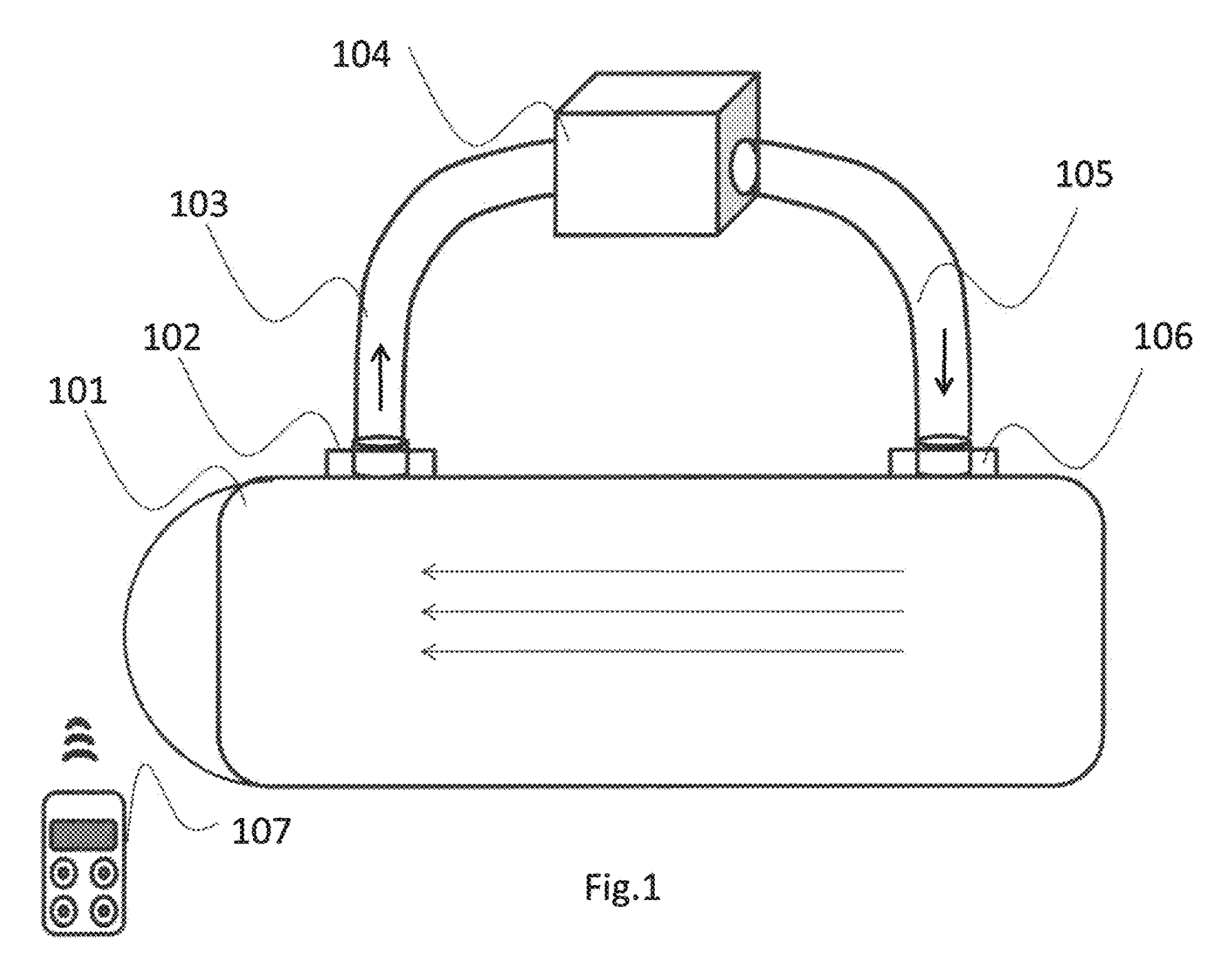
This patent gives the sleeping bag two air couplings and connects them to an external Peltier heat-exchanger module with flexible hoses. Conditioned air enters through one hose and returns through the other for recirculation.
A conventional sleeping bag isolates the body from outside weather. This design uses that small enclosed volume as an advantage, conditioning only the air immediately around the sleeper instead of an entire room.
- ASSIGNEE
- Individual
- PRIORITY
- 2021-08-30
- PUBLISHED
- 2022-06-28
- PUBLICATION
- US11369219B1
- INVENTORS
- Jacob Gitman / Victor Lander
AFTER THE FIGURES
Do not move the sleeper. Move everything around the sleeper.
Across these nine patents, very few ideas ask a sleeping person to do anything. The pillow moves the head, the bed rocks, speakers create a quiet zone near the ears, and a projector changes what appears overhead. The machinery works specifically because the user is supposed to remain asleep.
The boundary of bedding also keeps expanding. A bed becomes a controlled environment, part of it detaches as a wheelchair, and another machine can tidy the sheets afterward. Even a sleeping bag becomes a tiny climate-controlled room once it is connected to an external heat exchanger.
The patent drawings give sleep technology a physical form: lift, rock, enclose, separate, pull, and circulate air. The person is at their least active, while the objects around them become surprisingly mechanical.
SOURCES
Primary sources
- US20090089932A1 — Pillow to prevent snoring
- US20130060306A1 — Efficient circadian and related system modulation with a sleep mask
- US20200405998A1 — Sleep pod
- US20230255360A1 — Rocking bed that produces pitch, roll, translational and vibration movements
- US20040211006A1 — Automatic bed making apparatus
- US20120159705A1 — Bed and wheelchair
- US20040234080A1 — Sound canceling systems and methods
- US10987042B2 — Display system and display device
- US11369219B1 — Temperature controlled sleeping bag