Meta's patent drawings repeatedly connect the physical person and their tools with virtual space. A headset tries to give your face back to people standing outside it. Real hands and keyboards are brought into VR. Signals are collected from muscles at the wrist and even from inside the ear.
The deeper the virtual system becomes, the more precisely it needs to understand the physical person using it. Gloves return touch. Headsets read expressions. Legs outside the camera view are inferred. Optics change focus to follow virtual depth. Movements, sensations, tools and surrounding space are gradually converted into computer inputs and outputs.
The ten patents below are US publications centered on Meta Platforms Technologies. Meta Neural Band, Meta Quest Pro, Horizon Workrooms, Meta Quest 3 and Direct Touch provide close public product analogues for five entries, but From Patents has not verified one-to-one patent marking for those implementations.
Rebuild your hidden face on the outside of the headset
What is it?
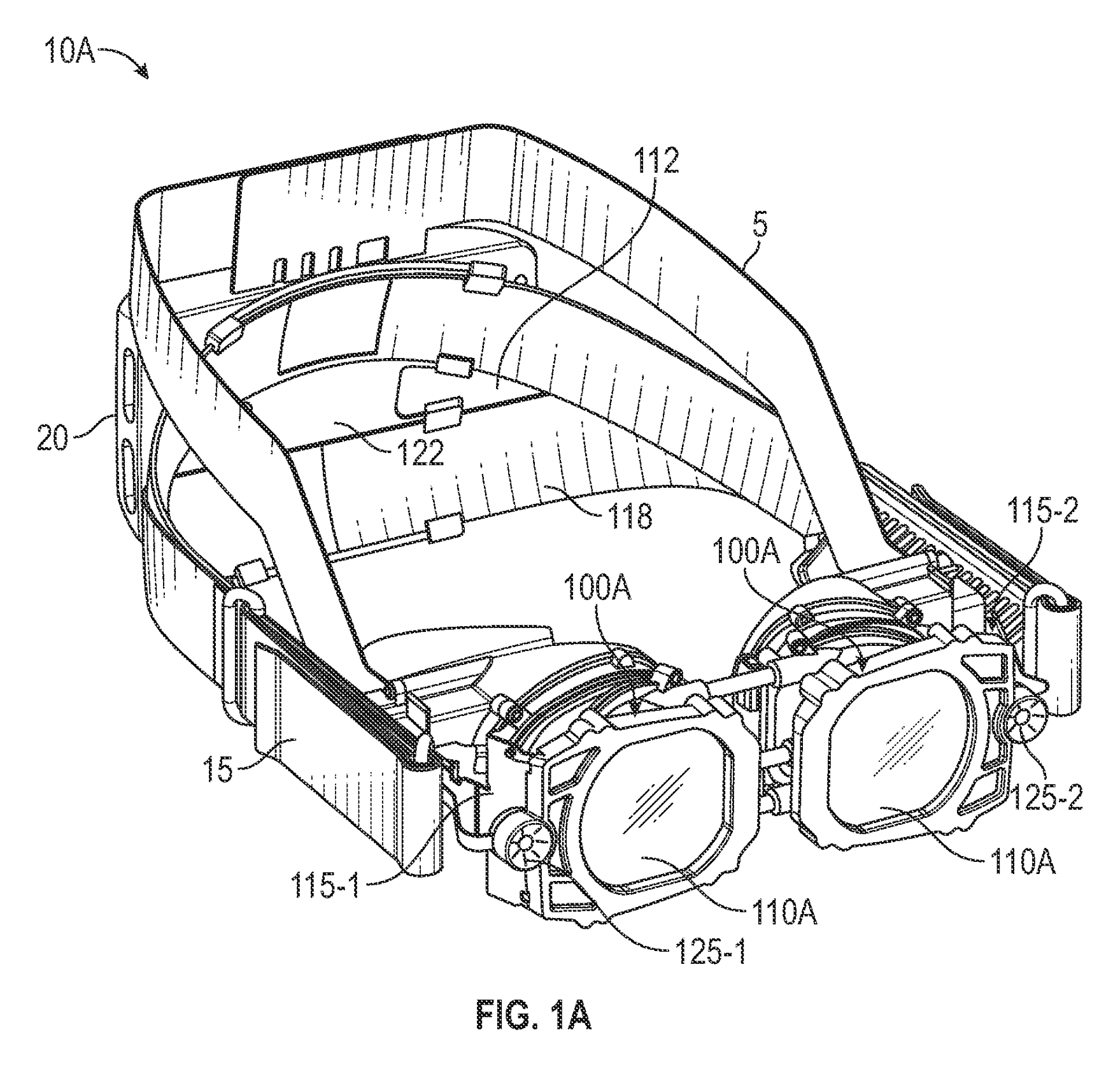
"Reverse pass-through glasses" describes an AR/VR device that reconstructs the portion of the user's face hidden by the headset and presents it on outward-facing displays. FIGS. 1A and 1B show the headset itself and the view presented to a forward onlooker.
A conventional VR headset hides the eyes and much of the expression as soon as it is worn. This proposal captures the missing face, reconstructs it computationally and presents a perspective-corrected three-dimensional view to people outside the headset.
- ASSIGNEE
- Meta Platforms Technologies LLC
- PRIORITY
- 2021-01-27
- PUBLISHED
- 2025-02-27
- PUBLICATION
- US20250071253A1
- INVENTORS
- Nathan Matsuda / Brian Wheelwright / Joel Hegland
Make a virtual object push back against your fingertips
What is it?
"Haptic actuators and related wearable devices" describes thin haptic actuators integrated into wearable forms such as gloves. FIG. 3 combines the glove, a fingertip cross-section and a detailed view of the actuator itself.
Tracking a hand in VR tells the system where the fingers are, but a virtual object does not physically stop them. By returning force to selected parts of the fingertips or palm, the glove can create a tactile boundary for something that exists only in the virtual scene.
- ASSIGNEE
- Meta Platforms Technologies LLC
- PRIORITY
- 2021-05-10
- PUBLISHED
- 2024-05-23
- PUBLICATION
- US20240168557A1
- INVENTORS
- DongSuk Shin / Benjamin Gorissen / Daniele Piazza / David Rother Dobbs / Erik Samuel Roby
Control the computer from muscle signals before the movement is obvious
What is it?
This patent describes a wrist-wearable device with multiple sensors arranged around the wrist to sense electrical signals associated with hand and finger movement. FIG. 1 presents the sensor pods as an annular band around the wrist.
Camera-based tracking can lose fingers when they are occluded or leave the field of view. EMG instead measures the electrical activity associated with producing the movement, including signals that can be present before the motion is visually obvious.
- ASSIGNEE
- Meta Platforms Technologies LLC
- PRIORITY
- 2013-08-16
- PUBLISHED
- 2025-01-23
- PUBLICATION
- US20250028286A1
- INVENTORS
- Matthew Bailey / Stephen Lake / Aaron Williams Grant / Cezar Morun
Read facial expressions with ultrasound and radio waves instead of a camera
What is it?
"Tracking facial expressions using ultrasound and millimeter waves" places transducers around a headset to illuminate portions of the face with acoustic or radio-frequency signals. FIG. 2 shows the sensing arrangement around the wearer's face.
Cameras can track expressions, but line of sight may be blocked by facial hair, headset structures or occlusion. This approach treats changes in distance and reflected waves as another way to recover the movement of the face.
- ASSIGNEE
- Meta Platforms Technologies LLC
- PRIORITY
- 2023-01-03
- PUBLISHED
- 2024-07-04
- PUBLICATION
- US20240219562A1
- INVENTORS
- Anton Andreevich Shkel / Gengxi Lu / Doruk Senkal / Julio Isla Garcia
Infer the legs that the headset cannot actually see
What is it?
"Predicting lower body movement for avatars" addresses the part of the body that head-mounted cameras often cannot observe well. FIG. 4 shows different user postures and the lower-body configurations inferred for them.
Signals can include headset height, visible knees or feet, inertial sensors and other cues. A trained model then estimates a physically plausible lower-body posture and merges it with the tracked upper body.
- ASSIGNEE
- Meta Platforms Technologies LLC
- PRIORITY
- 2023-03-30
- PUBLISHED
- 2024-10-03
- PUBLICATION
- US20240331250A1
- INVENTORS
- Jean-Charles Bazin / Sofien Bouaziz
Bring the physical keyboard into VR instead of replacing it
What is it?
"Physical keyboard tracking" uses headset imagery to identify a physical keyboard and estimate its pose so a virtual model can be registered at the same location. FIG. 7 illustrates the relationship between the real keyboard and its virtual representation.
Productivity in VR leaves one awkward physical object behind: the keyboard under the user's hands. Instead of replacing it with a purely virtual keyboard, this invention lets the digital environment adapt to the familiar real tool.
- ASSIGNEE
- Meta Platforms Technologies LLC
- PRIORITY
- 2020-12-01
- PUBLISHED
- 2023-12-26
- PUBLICATION
- US11854230B2
- INVENTORS
- Jan Herling / Daniel Scharstein
Open a small window into reality only around your hand
What is it?
"Partial Passthrough in Virtual Reality" proposes revealing only the parts of reality that matter at a particular moment. FIG. 6 shows a halo of passthrough imagery around the user's hand, with a nearby real coffee cup visible inside the virtual environment.
Removing the headset or switching the entire view to video every time the user reaches for an object breaks immersion. Partial passthrough instead opens a localized window around the hand when interaction with the physical world is needed.
- ASSIGNEE
- Meta Platforms Technologies LLC
- PRIORITY
- 2020-12-22
- PUBLISHED
- 2022-06-23
- PUBLICATION
- US20220197382A1
- INVENTORS
- Michael James LeBeau / John Nicholas Jitkoff
Move the optics so virtual depth changes where your eyes focus
What is it?
"Varifocal display with actuated reflectors" describes a head-mounted system that changes the focus state of its optics. FIG. 4 links the HMD, varifocal block, focus prediction, eye tracking and rendering system.
In ordinary stereoscopic VR, the eyes may converge on a virtual object that appears near or far while accommodation still focuses on a display at a fixed physical distance. The invention attempts to reduce that conflict by changing the optics as the viewed depth changes.
- ASSIGNEE
- Meta Platforms Technologies LLC
- PRIORITY
- 2016-12-20
- PUBLISHED
- 2024-02-20
- PUBLICATION
- US11906750B1
- INVENTORS
- Nicholas Daniel Trail
Remove the controller and turn the bare hand into the input device
What is it?
"Gesture-based control system" uses one or more cameras to recover the three-dimensional pose of a user's hands and interpret gestures as computer input. FIG. 4 shows a standing user interacting while cameras above the display observe the hands.
Earlier motion interfaces often relied on instrumented gloves or markers. This approach instead tries to reconstruct the fingers from images so the user's ordinary hand becomes the controller.
- ASSIGNEE
- Meta Platforms Technologies LLC
- PRIORITY
- 2012-03-20
- PUBLISHED
- 2017-10-12
- PUBLICATION
- US20170293364A1
- INVENTORS
- Robert Wang
Measure brain and heart signals from electrodes inside the ear
What is it?
"In-ear electrodes for AR/VR applications and devices" places electrodes and microphones in an in-ear fixture and connects the sensing system to an augmented-reality headset. FIG. 1 presents an architecture in which the in-ear monitor contributes to assessing the user's health.
The disclosure discusses brain activity through EEG, cardiac activity through ECG and eye-related signals such as EOG. An earbud-like form factor becomes not only an audio device but also a stable contact point for physiological sensing.
- ASSIGNEE
- Meta Platforms Technologies LLC
- PRIORITY
- 2022-02-02
- PUBLISHED
- 2023-08-03
- PUBLICATION
- US20230240608A1
- INVENTORS
- Morteza Khaleghimeybodi / Barry David Silverstein / Nils Thomas Fritiof Lunner / John Rumsfeld / Andrew John Ouderkirk / Joshua Weiner
AFTER THE FIGURES
In Meta's patents, the body and the physical world become computer peripherals
Across the patents, different parts of the body become interfaces. The face is reconstructed on an outward display, hands are tracked by cameras, muscle electricity becomes a click, and signals can even be collected from inside the ear. The routes for expressing intent spread across the body.
Physical tools and people also connect with the virtual space. A keyboard is aligned with its virtual counterpart. A small window into the real world opens only around a hand and nearby objects. A headset attempts to show a face to the person standing outside. The more immersive the system becomes, the more technology is needed to selectively restore the boundary with reality.
The result looks less like one futuristic computer and more like a system that turns the person and the surrounding environment into a giant input-output device. Looking, touching, smiling, sitting, moving a finger and sensing through the ear all become parts of the interface.
SOURCES
Primary sources
- US20250071253A1 — Reverse pass-through glasses for augmented reality and virtual reality devices
- US20240168557A1 — Haptic actuators and related wearable devices
- US20250028286A1 — Wearable devices and associated band structures for sensing neuromuscular signals and identifying hand gestures and methods of use thereof
- US20240219562A1 — Tracking facial expressions using ultrasound and millimeter waves
- US20240331250A1 — Predicting lower body movement for avatars
- US11854230B2 — Physical keyboard tracking
- US20220197382A1 — Partial Passthrough in Virtual Reality
- US11906750B1 — Varifocal display with actuated reflectors
- US20170293364A1 — Gesture-based control system
- US20230240608A1 — In-ear electrodes for ar/vr applications and devices