Honda's patent drawings extend mobility beyond cars and motorcycles. A biped robot walks while holding a person's hand, a five-finger hand manipulates objects, and another robot performs sign language. Elsewhere, machines carry part of a person's body weight and compact vehicles move in any direction while the rider remains seated.
The idea of mobility then expands into automated wheelchair-to-vehicle transfer, remotely operated robots, mobility that predicts and follows a walking person, and finally vertical flight. The recurring objective is not only to move people faster or farther, but to enlarge the range of places, postures and abilities in which a person can act.
These ten inventions are described in US patent publications. ASIMO, Bodyweight Support Assist, UNI-CUB and Honda eVTOL are documented Honda technologies with related functions, but one-to-one implementation of these patents in those technologies has not been verified.
Walk beside a person while holding their hand
What is it?
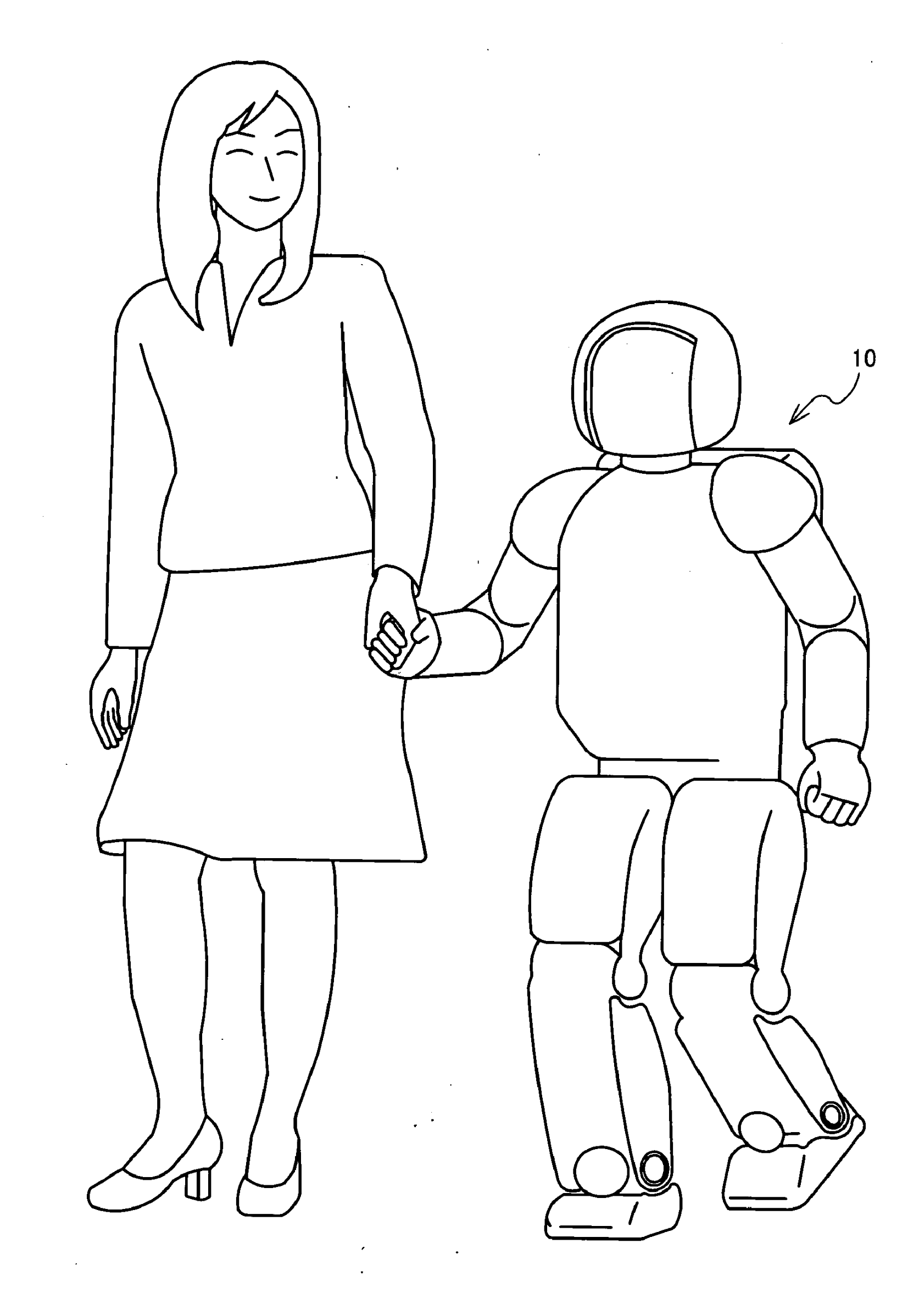
"Legged mobile robot control system" addresses a biped robot walking while holding a person's hand. External force at the hand can be used as part of the control input so the machine responds to the human rather than following only a fixed path.
Walking next to someone becomes a whole-body coordination problem: the physical connection between person and robot is itself a communication channel.
- ASSIGNEE
- Honda Motor Co Ltd
- PRIORITY
- 2005-12-12
- PUBLISHED
- 2007-06-28
- PUBLICATION
- US20070150107A1
- INVENTORS
- Naohide Ogawa / Satoshi Shigemi
Give the robot a palm, thumb and four more fingers
What is it?
"Robot hand" lays out a palm with five fingers corresponding to the thumb, index, middle, ring and little fingers. FIG. 1 makes the human-like arrangement immediately visible, while later figures develop the links and sensing structures inside the fingertips.
A two-jaw industrial gripper can be simpler, but a five-finger hand is better matched to tools and objects designed around human anatomy.
- ASSIGNEE
- Honda Motor Co Ltd
- PRIORITY
- 2003-09-12
- PUBLISHED
- 2007-01-25
- PUBLICATION
- US20070018470A1
- INVENTORS
- Masato Hayakawa / Takafumi Fukushima / Kazuhiro Kishimoto / Kazuyuki Takahashi
Make the transitions between sign-language words part of the robot's language
What is it?
"Sign language action generating device and communication robot" generates a series of sign-language motions from word-level actions. FIG. 2 shows the biped robot that performs the resulting movements.
Sign language is not only a set of static hand shapes. Moving from one word to the next must also be smooth and must avoid collisions between arms, fingers and the body.
- ASSIGNEE
- Honda Motor Co Ltd
- PRIORITY
- 2011-11-04
- PUBLISHED
- 2013-05-09
- PUBLICATION
- US20130115578A1
- INVENTORS
- Asuka Shiina / Yuji Nagashima
Let a machine carry part of your body weight while you keep walking
What is it?
"Walking assist device" combines a saddle-like load-transmitting seat with articulated links extending to the user's feet. Motors drive the links in a direction that pushes the seat upward, relieving part of the load on the legs.
The user still walks under their own power. Rather than replacing walking, the device changes how much of the body's weight the legs must carry.
- ASSIGNEE
- Honda Motor Co Ltd
- PRIORITY
- 2007-08-03
- PUBLISHED
- 2010-08-12
- PUBLICATION
- US20100204621A1
- INVENTORS
- Jun Ashihara / Yasushi Ikeuchi / Hiroshi Kudoh / Yutaka Hiki / Tatsuya Noda / Takeshi Koshiishi
Push a leaning upper body back toward its neutral posture
What is it?
"Motion assist apparatus" places actuators around the waist and connects them to frames attached to the thighs and upper body. The system assists returning from a forward-leaning posture and maintaining a tilted posture.
Unlike the leg-focused walking assist device, the target here is the torso and the muscular effort required to hold or recover a working posture.
- ASSIGNEE
- Honda Motor Co Ltd
- PRIORITY
- 2014-05-23
- PUBLISHED
- 2015-11-26
- PUBLICATION
- US20150335461A1
- INVENTORS
- Yasuhito Kuromiya / Hiroyuki Goto / Makoto Nakatsuka / Hideo Shimizu / Tatsuya Ishikawa
Move forward, backward, sideways or diagonally without a steering wheel
What is it?
"Omnidirectional vehicle" describes a compact seated mobility machine using an omnidirectional travel mechanism and inverted-pendulum-style posture control. FIG. 1 shows the narrow front profile of the vehicle.
Conventional vehicles separate forward travel from steering. This architecture is intended to move sideways and diagonally as well, making the machine behave more like a person moving through a room.
- ASSIGNEE
- Honda Motor Co Ltd
- PRIORITY
- 2009-11-13
- PUBLISHED
- 2011-05-19
- PUBLICATION
- US20110118968A1
- INVENTORS
- Toru Takenaka / Kazushi Akimoto
Let the wheelchair navigate itself into the vehicle
What is it?
"Automated mobility device and vehicle interface" links a motorized wheelchair or similar device with a vehicle. FIG. 7 shows the mobility device positioned inside the vehicle, while the specification describes automatic positioning and navigation using visual data.
For a wheelchair user, entering a car can involve moving the mobility device itself, not merely transferring the passenger into another seat. The patent treats that transition as part of one mobility system.
- ASSIGNEE
- Honda Motor Co Ltd
- PRIORITY
- 2018-10-10
- PUBLISHED
- 2020-04-16
- PUBLICATION
- US20200113755A1
- INVENTORS
- Shigeyuki Seko / Shinichi Akama / Brian W. Johnson
Make a remote robot's torso move with the user's voice
What is it?
The 2024 publication "Robot" describes a self-propelled base, torso and camera-equipped head that can transmit captured images to a user terminal. Around the torso is a separate cover connected through elastic members and driven so that it can swing in multiple directions.
Some claims describe receiving the remote user's audio and making the cover oscillate with different timing when the user speaks or laughs. The mechanism adds physical expression to a telepresence-style machine, alongside video and sound.
- ASSIGNEE
- Honda Motor Co Ltd
- PRIORITY
- 2021-03-19
- PUBLISHED
- 2024-05-16
- PUBLICATION
- US20240157569A1
- INVENTORS
- Takeshi Koshiishi / Yasushi Takahashi / Masaki Ueyama
Predict where a shopper is turning and let the cart follow by itself
What is it?
"Accompanying mobile body" goes beyond keeping a fixed measured distance behind a person. It predicts the user's future position from movement direction and speed, then drives toward an accompanying target. FIG. 14 shows the cart keeping its distance as it overtakes a sharply turning user and moves ahead.
A simple follower can lag when a person turns suddenly. The patent describes changing the prediction timing and following behavior using cues such as body, head or gaze direction.
- ASSIGNEE
- Honda Motor Co Ltd
- PRIORITY
- 2019-01-22
- PUBLISHED
- 2022-01-27
- PUBLICATION
- US20220026914A1
- INVENTORS
- Toru Kawai / Hiroki Mukai / Hiroto Takahashi
Lift off with eight VTOL rotors, then cruise with two more
What is it?
FIG. 1 of "Vertical take-off and landing aircraft" shows a fuselage, front and rear wings, two longitudinal booms, eight VTOL rotors and two cruise rotors. Lift and forward propulsion are split between different rotor groups.
Rather than asking one rotor system to perform every phase, the design separates vertical work from cruise propulsion and uses fixed wings once the aircraft is moving forward.
- ASSIGNEE
- Honda Motor Co Ltd
- PRIORITY
- 2022-07-29
- PUBLISHED
- 2024-06-13
- PUBLICATION
- US20240190562A1
- INVENTORS
- Bon Aizawa / Toshinori Tsukamoto / Masashi Kato / Kenta Uchida / Kaisaku Yoshimura
AFTER THE FIGURES
Honda's idea of mobility keeps moving closer to the human body
Across these drawings, mobility begins with walking beside someone, grasping with a hand and taking some load away from the legs or torso. Honda repeatedly treats small human motions as engineering problems worth assisting.
The same logic scales into personal mobility, wheelchair and vehicle coordination, remote presence and accompanying mobility. Sometimes the person rides the machine; sometimes the machine moves on the person's behalf.
Add eVTOL and the range stretches from body support to the sky. The common thread is the gradual removal of constraints on where and how a person can move.
SOURCES
Primary sources
- US20070150107A1 — Legged mobile robot control system
- US20070018470A1 — Robot hand
- US20130115578A1 — Sign language action generating device and communication robot
- US20100204621A1 — Walking assist device
- US20150335461A1 — Motion assist apparatus
- US20110118968A1 — Omnidirectional vehicle
- US20200113755A1 — Automated mobility device and vehicle interface
- US20240157569A1 — Robot
- US20220026914A1 — Accompanying mobile body
- US20240190562A1 — Vertical take-off and landing aircraft