Motorized shoes manage the boundary between a virtual walk and a physical room. A sleeve becomes an input surface, and a walking stick records its surroundings. These ten Google patent documents place sensing, communication and control inside objects beyond the familiar computer screen.
The collection also follows information between bodies and places: a robot personality can be shared, a replacement robot can take over a task, and balloons can form a communications network. Related projects such as Jacquard, Soli and Loon remain distinct from verified use of these exact patents.
Keep a struck pedestrian on the car with an adhesive hood
What is it?
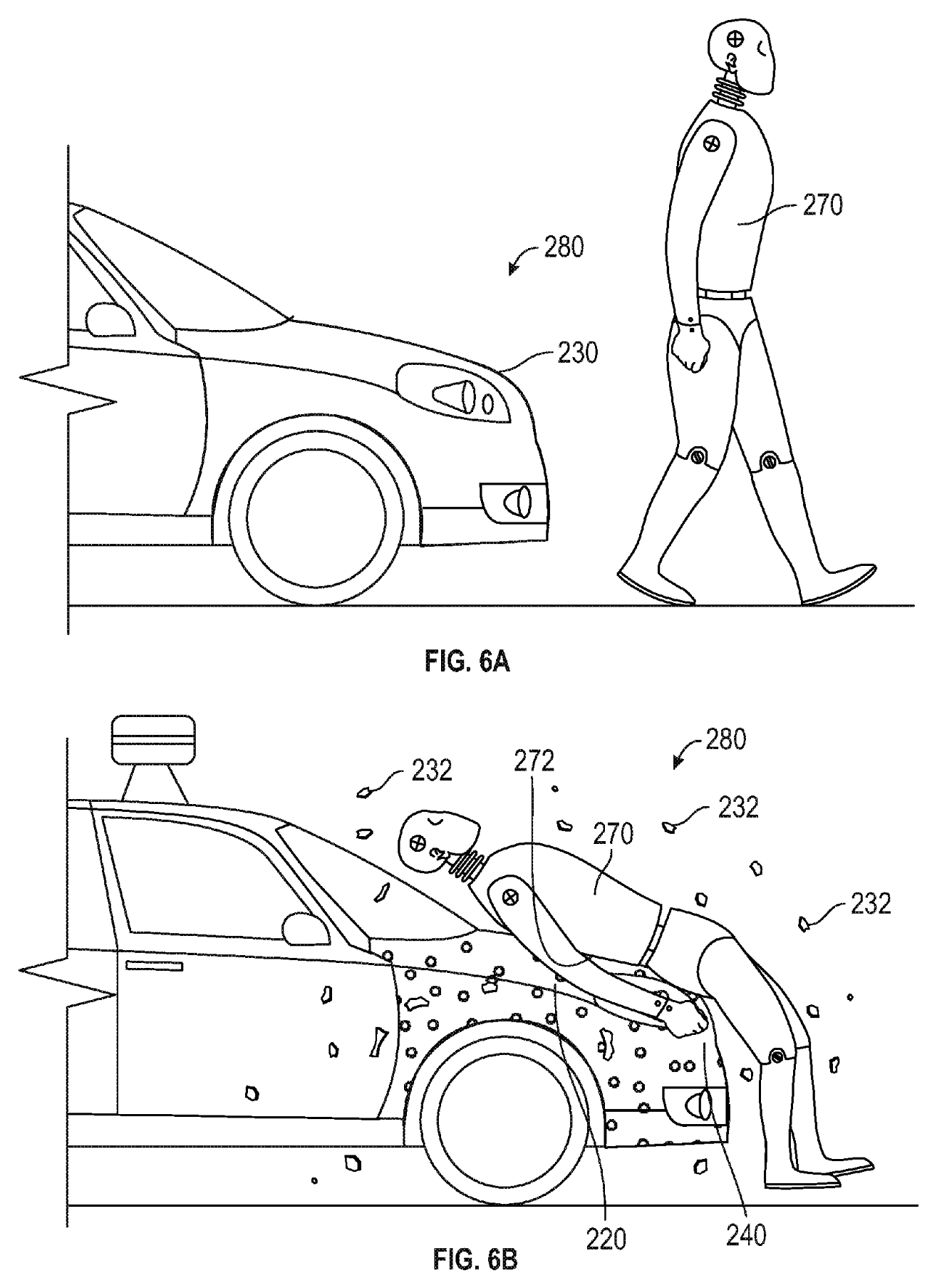
FIG. 6A and FIG. 6B show the proposed sequence before and after a collision. A protective coating covers an adhesive layer during ordinary use, then breaks on impact to expose the sticky surface.
The purpose is to reduce a subsequent collision with the road or another object by retaining the pedestrian on the vehicle. These are drawings of a proposed safety mechanism, not crash-test results or proof of injury reduction.
- ASSIGNEE
- Google Inc.
- PRIORITY
- 2013-12-04
- PUBLISHED
- 2016-05-17
- PUBLICATION
- US9340178B1
- INVENTORS
- Alex Khaykin / Daniel Lynn Larner
Let VR shoes move your feet back toward the center
What is it?
The wheeled shoes appear at the feet of the user in FIG. 1. The patent describes tracking their position and driving them toward a return zone when the user approaches the boundary of the available physical space.
FIG. 13A and FIG. 13B show the associated head-mounted display, including its opened housing. The footwear mechanism is described elsewhere in the document; these close-ups should not be read as shoe diagrams.
- ASSIGNEE
- Google LLC
- PRIORITY
- 2017-05-09
- PUBLISHED
- 2018-11-15
- PUBLICATION
- US20180326286A1
- INVENTORS
- Nidhi Rathi / Maksim Ratner
Let a contact lens read the wearer’s iris
What is it?
Follow the diagram from the light source to the eye and then to the iris fingerprint reader. The document describes light sensors on or within the contact lens facing the iris and detecting light reflected from it.
Readout circuitry supplies information about the iris pattern for processing and comparison. The overview shows the information flow; it does not show the individual miniature components in detail.
- ASSIGNEE
- Google Inc.
- PRIORITY
- 2012-05-15
- PUBLISHED
- 2014-08-05
- PUBLICATION
- US8798332B2
- INVENTORS
- Brian Otis / Babak Amirparviz
Store a robot personality in the cloud and reuse it in another body
What is it?
The left-hand drawings separate a robot into processing, sensing and mechanical components, then show two possible bodies. On the right, several robots connect through a cloud and a database.
The patent describes adjusting a robot personality using information about a user and transferring personality information between robotic bodies. Here, personality means configurable behavior and responses; the document does not establish machine consciousness.
- ASSIGNEE
- Google Inc.
- PRIORITY
- 2011-05-06
- PUBLISHED
- 2015-03-31
- PUBLICATION
- US8996429B1
- INVENTORS
- Anthony G. Francis, Jr. / Thor Lewis
Put propellers on a telepresence screen and fly it around
What is it?
FIG. 9 combines a four-rotor aircraft with a smartphone dock, mirrors and a display screen. The patent describes using the phone for communication and processing, with a mirror directing projected imagery onto the screen.
A second mirror routes a view of the room toward the phone camera. Together with audio input and output, this creates a proposed two-way presence that a remote participant can move through a space.
- ASSIGNEE
- Google LLC / Wing Aviation LLC
- PRIORITY
- 2015-03-02
- PUBLISHED
- 2016-08-09
- PUBLICATION
- US9409645B1
- INVENTORS
- Clark Sopper / Adam Woodworth / Clayton Woodward Bavor, Jr.
Turn a jacket sleeve into a touchpad
What is it?
The sleeve detail in FIG. 1 marks an interactive region of the garment. Follow the touch-data path upward to the computing device, where a gesture manager and applications use the input.
The patent describes conductive threads woven into fabric and sensing circuitry that detects touch positions. Gestures such as taps or swipes can then become commands while the input surface remains part of the clothing.
- ASSIGNEE
- Google LLC
- PRIORITY
- 2016-05-16
- PUBLISHED
- 2020-07-23
- PUBLICATION
- US20200229515A1
- INVENTORS
- Ivan Poupyrev / Carsten C. Schwesig / Mustafa Emre Karagozler / Hakim Kader Bhai Raja / David Scott Allmon / Gerard George Pallipuram / Shiho Fukuhara / Nan-Wei Gong
Use wrist radar to read tiny finger movements
What is it?
The shaded fan in FIG. 7 extends from the wrist device across the hand. The document identifies it as a planar radar field and describes recognizing gestures from interactions within that field.
Small finger movements can become input without pressing a physical control. The diagram shows the sensing region in relation to the hand, rather than a visible display projected onto the skin.
- ASSIGNEE
- Google LLC
- PRIORITY
- 2014-06-03
- PUBLISHED
- 2018-05-15
- PUBLICATION
- US9971415B2
- INVENTORS
- Ivan Poupyrev / Gaetano Roberto Aiello
Link stratospheric balloons with light to build an internet network in the sky
What is it?
FIG. 1 shows a network of balloons with links to ground stations. FIG. 3 expands one balloon into its payload, labeling optical and radio communication systems alongside computing, power and positioning equipment.
The patent describes a hierarchy in which super-node balloons communicate optically and connect to sub-nodes by radio. Ground connections can use different arrangements, including the optical downlink drawn at the lower left.
- ASSIGNEE
- Google Inc.
- PRIORITY
- 2012-01-09
- PUBLISHED
- 2014-05-06
- PUBLICATION
- US8718477B2
- INVENTORS
- Richard Wayne DeVaul / Eric Teller / Clifford L. Biffle / Josh Weaver
Swap one robot for another in the middle of a task
What is it?
Read FIG. 2A through FIG. 2C as a sequence. A second robot approaches the working robot, the machines meet near the user, and their positions change as the replacement takes over.
The patent describes deciding when a robot needs replacement, selecting another available robot and coordinating the handoff. A battery expected to run too low before the task ends is one possible trigger.
- ASSIGNEE
- X Development LLC
- PRIORITY
- 2015-08-08
- PUBLISHED
- 2017-11-21
- PUBLICATION
- US9821455B1
- INVENTORS
- Mallinath Bareddy
Capture the surroundings every time a camera-equipped walking stick touches the ground
What is it?
The camera sits above the grip in FIG. 1, while the switch is near the bottom tip. The patent describes using ground contact to trigger pictures of the surroundings, with GPS and an inertial measurement unit providing additional position and motion information.
A processing system can combine the images and sensor information into a virtual representation of the environment. Ground contact supplies a repeatable capture event as the user moves along a route.
- ASSIGNEE
- Google Inc.
- PRIORITY
- 2011-09-21
- PUBLISHED
- 2013-06-18
- PUBLICATION
- US8467674B1
- INVENTORS
- Daniel Jason Ratner / Russell Leigh Smith
AFTER THE FIGURES
Computing through everyday objects
The common thread is a change in where interaction happens. Fabric, a hand, an eye and a walking stick become sources of information, while powered shoes and an adhesive vehicle surface act on the physical world. These proposals give ordinary objects new sensing or control roles.
The robot examples separate behavior and task continuity from a single body. The flying telepresence system and balloon network extend that separation across distance. Read together, the documents offer different ways to connect computation with physical surroundings.
SOURCES
Primary sources
- US9340178B1 — Adhesive vehicle front end for mitigation of secondary pedestrian impact
- US20180326286A1 — Augmented and/or virtual reality footwear
- US8798332B2 — Contact lenses
- US8996429B1 — Methods and systems for robot personality development
- US9409645B1 — Unmanned aerial vehicle for collaboration
- US20200229515A1 — Interactive fabric
- US9971415B2 — Radar-based gesture-recognition through a wearable device
- US8718477B2 — Balloon network with free-space optical communication between super-node balloons and RF communication between super-node and sub-node balloons
- US9821455B1 — Replacing a first robot with a second robot during performance of a task by the first robot
- US8467674B1 — Walking stick with IMU