Dyson is associated with vacuum cleaners and bladeless fans. Across its patent drawings, however, the same engineering ideas keep changing jobs. An air purifier moves onto the head, narrow jets push water off hands, controlled flows style hair, and a familiar ring-shaped fan becomes a humidifier.
Cleaning breaks into equally surprising tasks. A cylinder vacuum is shaped to slide up stairs when pulled by the user; green light reveals dust before suction begins; a robot carries cyclones through the room; and a dock is designed to remove tangled hair from the cleaning device itself. Alongside them appears a robot hand whose fingers are deliberately unequal.
These ten inventions appear in US patent publications. Dyson sells products with related functions, but implementation of these specific patents in those products has not been verified.
Carry a personal air purifier right in front of your face
What is it?
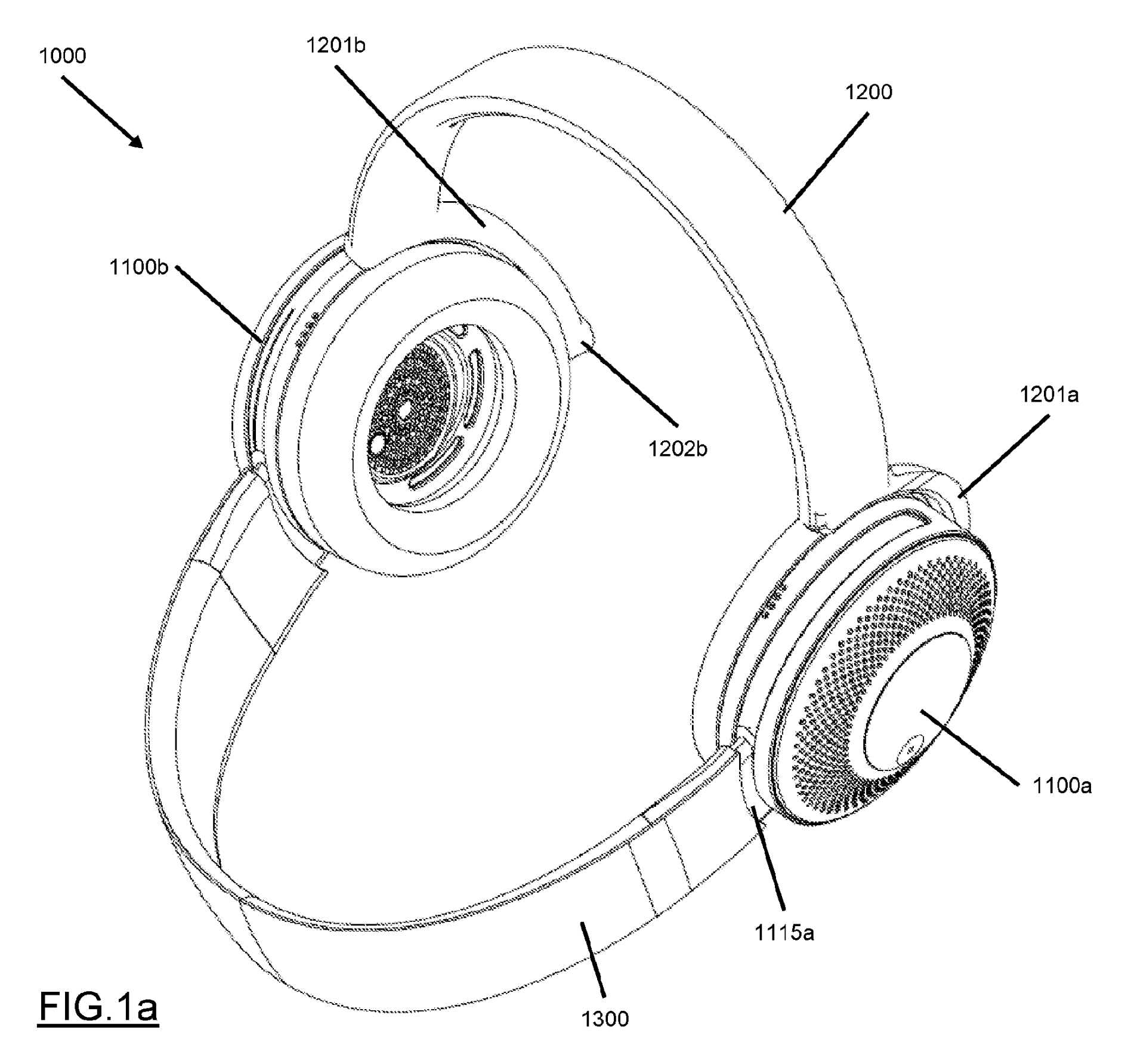
This patent integrates purification hardware into headphone speaker assemblies and delivers airflow toward the user's face. FIG. 1 shows the combined headset and forward air-delivery structure.
Ordinary purifiers clean the air in a room. This proposal instead treats the air immediately before inhalation as the target and moves the equipment with the person.
- ASSIGNEE
- Dyson Technology Ltd
- PRIORITY
- 2018-07-23
- PUBLISHED
- 2021-08-26
- PUBLICATION
- US20210260415A1
- INVENTORS
- Philip Stephen Darling / Matthew Jerome Jennings / Peter Knight Reid
Shape a vacuum so it can be pulled up the stairs
What is it?
This older Dyson patent gives a cylinder-type vacuum a recessed underside that accommodates a stair nosing, with an inclined front surface for moving upward. FIG. 1 presents the cleaner in the stair-use configuration.
It is not a self-driving stair-climbing robot. The user still pulls the hose; the invention changes the machine's shape so the stairs support it and make upward movement easier.
- ASSIGNEE
- Notetry Ltd (later Dyson Technology Ltd)
- PRIORITY
- 1995-01-27
- PUBLISHED
- 1999-08-17
- PUBLICATION
- US5937477A
- INVENTORS
- James Dyson
Build an uneven robotic hand to pick up small things
What is it?
This Dyson patent describes an opposed two-finger robotic gripper whose fingers contain different numbers of segments. FIG. 1 introduces the asymmetric hand architecture.
An uneven finger design can serve the geometry of the object and the nearby work surface.
- ASSIGNEE
- Dyson Technology Ltd
- PRIORITY
- 2020-02-27
- PUBLISHED
- 2023-03-02
- PUBLICATION
- US20230064919A1
- INVENTORS
- Andrew James Shaw / Vincent Denis Clerc
Remove the visible blades and let a hollow ring shape the wind
What is it?
The Dyson fan patent directs internally generated airflow through a ring-shaped nozzle. FIG. 1 shows an unmistakable outline: a fan with a wide opening where its blades would normally be.
The blades are hidden inside the machine, while the ring conditions the outgoing flow.
- ASSIGNEE
- Dyson Technology Ltd
- PRIORITY
- 2007-09-04
- PUBLISHED
- 2009-03-05
- PUBLICATION
- US20090060711A1
- INVENTORS
- Peter David Gammack / Frederic Nicolas / Kevin John Simmonds
Remove water with a thin blade made of air
What is it?
This patent is specifically about the design and manufacturing assembly of narrow hand-dryer nozzle slots. The drawing focuses on the geometry that makes a consistent narrow sheet of air possible.
Rather than depending solely on heat to evaporate moisture, an air-knife dryer pushes water off the skin with thin, fast-moving flows. That places unusual demands on the nozzle's precision.
- ASSIGNEE
- Dyson Technology Ltd
- PRIORITY
- 2011-10-20
- PUBLISHED
- 2013-04-25
- PUBLICATION
- US20130097885A1
- INVENTORS
- James Dyson / Leigh Michael Ryan / Robert Michael Cox
Let the air wrap hair around the styling attachment
What is it?
This haircare patent develops an attachment whose outlet structures guide the flow around the device. FIG. 1 presents the attachment that uses moving air as an active styling tool.
Instead of relying only on a clamp or a hot curling iron, the styling process uses the flow of air to guide strands toward the attachment.
- ASSIGNEE
- Dyson Technology Ltd
- PRIORITY
- 2020-09-18
- PUBLISHED
- 2024-01-11
- PUBLICATION
- US20240008618A1
- INVENTORS
- Robert Mark Brett Coulton / Martin Edward Keane / Peter Dabbs
Shine grazing green light across the floor to reveal hidden dust
What is it?
This patent places a green laser diode on the vacuum cleaner head to illuminate debris on the surface ahead of the cleaning path. FIG. 1 shows the cleaner-head architecture and the illumination arrangement.
Even strong suction is less useful when the person cannot see where the fine dust remains. The invention optimizes illumination geometry so very small particles become more visible.
- ASSIGNEE
- Dyson Technology Ltd
- PRIORITY
- 2020-01-31
- PUBLISHED
- 2023-02-02
- PUBLICATION
- US20230036398A1
- INVENTORS
- Stephen Robert Dimbylow / Andrew David Warrington / Henry Thomas James Barnard
Give the floor cleaner a dock that removes hair tangled in the cleaner head
What is it?
After the floor is clean, hair may still be wound around the cleaning head. This patent proposes a special dock that receives the cleaner and provides a hair-removal mechanism.
The document describes alternatives including cutter-and-hook arrangements and toothed combs. Its specific contribution is maintaining the cleaning head, not merely washing the floor.
- ASSIGNEE
- Dyson Technology Ltd
- PRIORITY
- 2021-02-26
- PUBLISHED
- 2024-05-02
- PUBLICATION
- US20240138646A1
- INVENTORS
- Oliver Dodgson
Pack cyclonic separation into a vacuum that drives itself
What is it?
This patent designs an autonomous vacuum with cyclonic separation equipment carried on its small chassis. FIG. 1 introduces the body and its internal dust-handling system.
A human-operated vacuum can devote a long vertical body to separation, but a robot needs compact dimensions to move underneath furniture. Its airflow machinery must fit inside a moving platform.
- ASSIGNEE
- Dyson Technology Ltd
- PRIORITY
- 2011-02-04
- PUBLISHED
- 2014-01-16
- PUBLICATION
- US20140013538A1
- INVENTORS
- James Dyson / Peter David Gammack
Turn the hollow fan into a machine that also humidifies
What is it?
The humidifying patent places water-handling components in a base beneath an annular airflow nozzle. FIG. 1 may look like the bladeless fan earlier in this article, but here the output involves moisture as well as moving air.
A humidifier must coordinate water with an airflow system. The same external ring can conceal different work inside the appliance.
- ASSIGNEE
- Dyson Technology Ltd
- PRIORITY
- 2012-03-06
- PUBLISHED
- 2014-03-20
- PUBLICATION
- US20140077398A1
- INVENTORS
- Mark Joseph Staniforth / Daniel James Beavis / Jude Paul Pullen / James Dyson / Nicholas Gerald Fitton
AFTER THE FIGURES
Dyson's inventions reorganize not just appliance shapes, but the jobs machines perform
The recurring idea is to separate airflow and cleaning operations from a fixed appliance silhouette. Air is delivered to the face rather than the whole room; the same general field of flow engineering can remove water or influence the shape of hair.
The cleaning patents also separate finding dirt, transporting the machine, capturing dust, separating particles and maintaining the cleaner afterward. A stair-supporting cylinder and an autonomous robot solve different problems, but both change how the human and the device share the work.
These drawings show how rearranging familiar physical mechanisms can produce a strikingly different set of possible everyday appliances.
SOURCES
Primary sources
- US20210260415A1 — Wearable air purifier
- US5937477A — Vacuum cleaner
- US20230064919A1 — Robot hand
- US20090060711A1 — Fan
- US20130097885A1 — Developments in or relating to a hand dryer
- US20240008618A1 — Attachment for a haircare appliance
- US20230036398A1 — Cleaner head for a vacuum cleaner
- US20240138646A1 — Floor cleaner dock
- US20140013538A1 — Autonomous vacuum cleaner
- US20140077398A1 — Humidifying apparatus