An aircraft cabin cannot simply grow whenever another function is needed. Airbus patent drawings repeatedly address this limit by making seats, walls, doors, stairs and lavatories do more than one job within that fixed volume.
A seat pan becomes closer to a saddle, a headrest wraps around the passenger, and a crew seat moves onto a door. Vertical space becomes stacked sleeping boxes, while space that must remain clear at one phase of flight can become a stairway at another. The emphasis is on what else the same space can become, rather than what can be added.
These eight US patent publications explore ways to reuse cabin space. Airbus has separately announced lower-deck passenger sleeping facilities and Space-Flex cabin solutions that pursue similar uses of space, but we have not verified one-to-one implementation of the patents discussed here in those products.
Turn the seat into a saddle-like perch
What is it?
"Seating device comprising a forward-foldable backrest" changes an aircraft seat between use and reduced-bulk configurations. The specification explicitly describes a motorcycle-type saddle with a narrower, raised front section, allowing the seating position to be raised without making the passenger stand.
The backrest also moves forward and upward rather than merely reclining. The goal is to reduce how far an unused seat projects into the space needed to reach seats farther along the row.
- ASSIGNEE
- Airbus Operations SAS
- PRIORITY
- 2012-12-12
- PUBLISHED
- 2014-06-12
- PUBLICATION
- US20140159444A1
- INVENTORS
- Bernard Guering
Put the passenger's head inside the headrest
What is it?
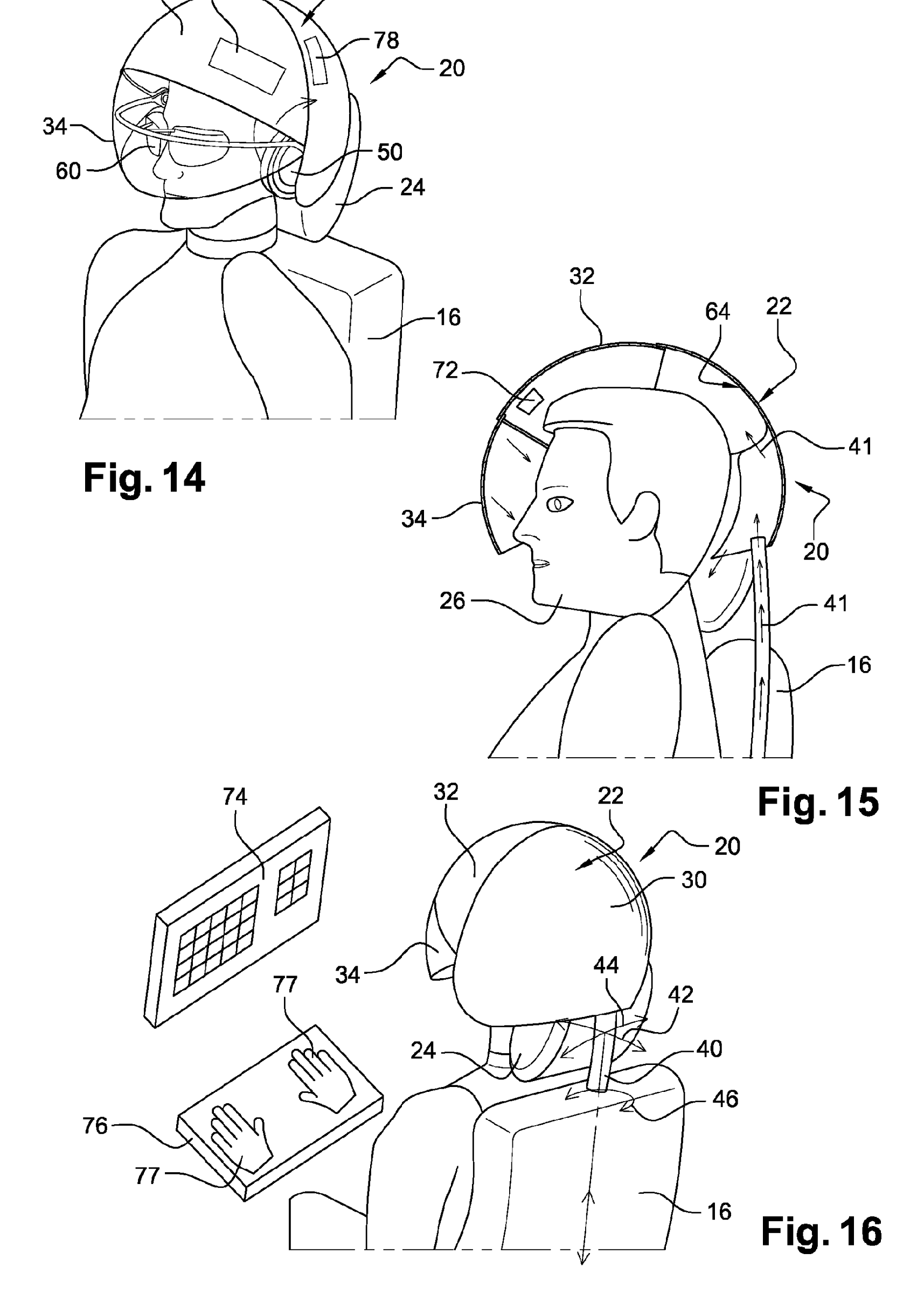
"Headrest for a passenger seat for an aircraft" combines a conventional support with a helmet that at least partially houses the passenger's head. The helmet can move vertically and fore-aft so it can be positioned around the passenger and moved away when not wanted.
The patent also describes image glasses, earphones, airflow and sections whose transparency can change. Rather than asking a passenger to look toward a screen in the cabin, it turns the immediate space around the head into the entertainment and isolation device.
- ASSIGNEE
- Airbus Operations SAS
- PRIORITY
- 2010-01-29
- PUBLISHED
- 2012-11-22
- PUBLICATION
- US20120292960A1
- INVENTORS
- Bernard Guering
Turn the lavatory door into a crew seat
What is it?
"Module for an aircraft cabin with a seat fastened to a door" attaches a seat directly to the door of a cabin module. Rather than reserving one wall area for the door and another for an attendant seat, both functions are combined on a single movable surface.
Cabin monuments, aisles and attendant seats all compete for tightly controlled floor and wall space. The invention challenges the assumption that the area occupied by a door can serve only the door.
- ASSIGNEE
- Airbus Operations GmbH
- PRIORITY
- 2014-02-24
- PUBLISHED
- 2016-12-08
- PUBLICATION
- US20160355266A1
- INVENTORS
- Christian Seibt
Stack sleeping boxes three levels high
What is it?
"Sleeping box, sleeping box arrangement and aircraft area" describes elongated enclosures sized for a person to lie down and arrangements that combine multiple boxes. Instead of asking a passenger seat to recline farther, it creates a dedicated small volume for sleeping.
Stacking the boxes uses height as well as floor area. A portion of the aircraft can therefore be planned less like a two-dimensional seating chart and more like a three-dimensional rack of occupied spaces.
- ASSIGNEE
- Airbus Operations GmbH
- PRIORITY
- 2014-03-19
- PUBLISHED
- 2015-09-24
- PUBLICATION
- US20150266581A1
- INVENTORS
- Frank Roese / Carsten Putensen
Use the same zone as a stairway only when needed
What is it?
"Stairway for an aircraft" connects a lower and higher level while making the steps nearest the lower level movable as a group. The patent specifically discusses connecting day and night spaces in an aircraft.
Raising the lower steps returns the occupied floor to another use. The idea is to deploy a circulation path only when it is useful instead of permanently assigning cabin area to the stairway.
- ASSIGNEE
- Airbus Operations SAS
- PRIORITY
- 2007-05-31
- PUBLISHED
- 2012-08-02
- PUBLICATION
- US20120193472A1
- INVENTORS
- Bernard Guering / Jonathan Guering
Make the seat back part of the cabin wall
What is it?
"Functional unit in a passenger cabin" splits a passenger seat into upper and lower constructional units. The backrest is attached to a support such as a cabin monument wall, while the seat frame, seat element and restraint are attached separately at the floor.
Wall and seat are normally independent objects placed next to each other. Here the wall supports the upper half of the seat, and the lower seat element may also be foldable to clear space when it is not being used.
- ASSIGNEE
- Airbus Operations GmbH
- PRIORITY
- 2017-03-30
- PUBLISHED
- 2018-10-04
- PUBLICATION
- US20180281972A1
- INVENTORS
- Sönke Jacobsen / Marcus Stahlfast / Juliane Gerken / Sven Mittelstaedt / Julian Harpenau / Fabian Nowacki
Compress the lavatory into a modular unit
What is it?
"Modular lavatory assembly" treats the aircraft lavatory as a configurable assembly rather than one fixed box. A base lavatory and additional service modules can be arranged to suit the available cabin envelope and the functions the operator needs.
At the rear of an aircraft, lavatories, galleys, aisles and passenger seats compete for the same cabin length. Breaking the lavatory into configurable elements creates another way to redistribute that space.
- ASSIGNEE
- Airbus Operations GmbH
- PRIORITY
- 2014-04-28
- PUBLISHED
- 2017-02-16
- PUBLICATION
- US20170043875A1
- INVENTORS
- Martijn Vervaet / Torben Hennig / Michael Lau / Julia Rotenberger
Make the cockpit folding seat double as a barrier
What is it?
"Aircraft flight deck comprising a folding seat" places a folding auxiliary seat in the constrained corridor around the flight deck. The patent describes configurations in which the seat can also help close off the corridor.
Other embodiments describe a reinforced rear face and a ladder mounted on the back. The auxiliary seat can therefore support protection and access functions as well as provide a place to sit.
- ASSIGNEE
- Airbus Operations SAS
- PRIORITY
- 2011-09-30
- PUBLISHED
- 2013-05-23
- PUBLICATION
- US20130126671A1
- INVENTORS
- Bernard Guering
AFTER THE FIGURES
Airbus cabin patents keep layering functions onto the same space
In these eight drawings, few cabin components remain single-purpose. A seat retracts, a wall carries a backrest, a door carries a crew seat, and a flight-deck folding seat can also help close off or provide access to the surrounding space.
Time is another design dimension. If a zone must be clear for one phase of flight but can be occupied in cruise, the same floor area can switch jobs instead of remaining permanently dedicated to one function. The cabin becomes a system that changes state rather than a static floor plan.
The resulting patents explore how to make full use of a tightly constrained cabin. Their appeal lies in watching the familiar boundaries between seat and wall, door and furniture, or aisle and stairway become progressively less fixed.
SOURCES
Primary sources
- US20140159444A1 — Seating device comprising a forward-foldable backrest
- US20120292960A1 — Headrest for a passenger seat for an aircraft
- US20160355266A1 — Module for an aircraft cabin with a seat fastened to a door
- US20150266581A1 — Sleeping box, sleeping box arrangement and aircraft area
- US20120193472A1 — Stairway for an aircraft
- US20180281972A1 — Functional unit in a passenger cabin, including a support unit and a passenger seat system
- US20170043875A1 — Modular lavatory assembly for a vehicle cabin, cabin of a vehicle and aircraft having a cabin and at least one modular lavatory arrangement
- US20130126671A1 — Aircraft flight deck comprising a folding seat