The basic job of a toilet is simple: sit, use it, flush. Patent drawings show how much engineering can accumulate around that routine. Toilets start playing audio, changing light, identifying users, measuring waste, collecting urine, cleaning themselves, and even moving their own seat and bowl.
The inventions do not all move in the same direction. Some add comfort. Some turn the toilet into a health instrument. Others automate cleaning, collapse the fixture into portable furniture, or reshape the toilet around the person using it. The same familiar object becomes a platform for very different ideas.
Only the first entry is marked related because Kohler sells a current smart toilet with several similar capabilities, without claiming a one-to-one implementation of this patent.
The toilet personalizes light, sound, sensors, and even how the lid moves
What is it?
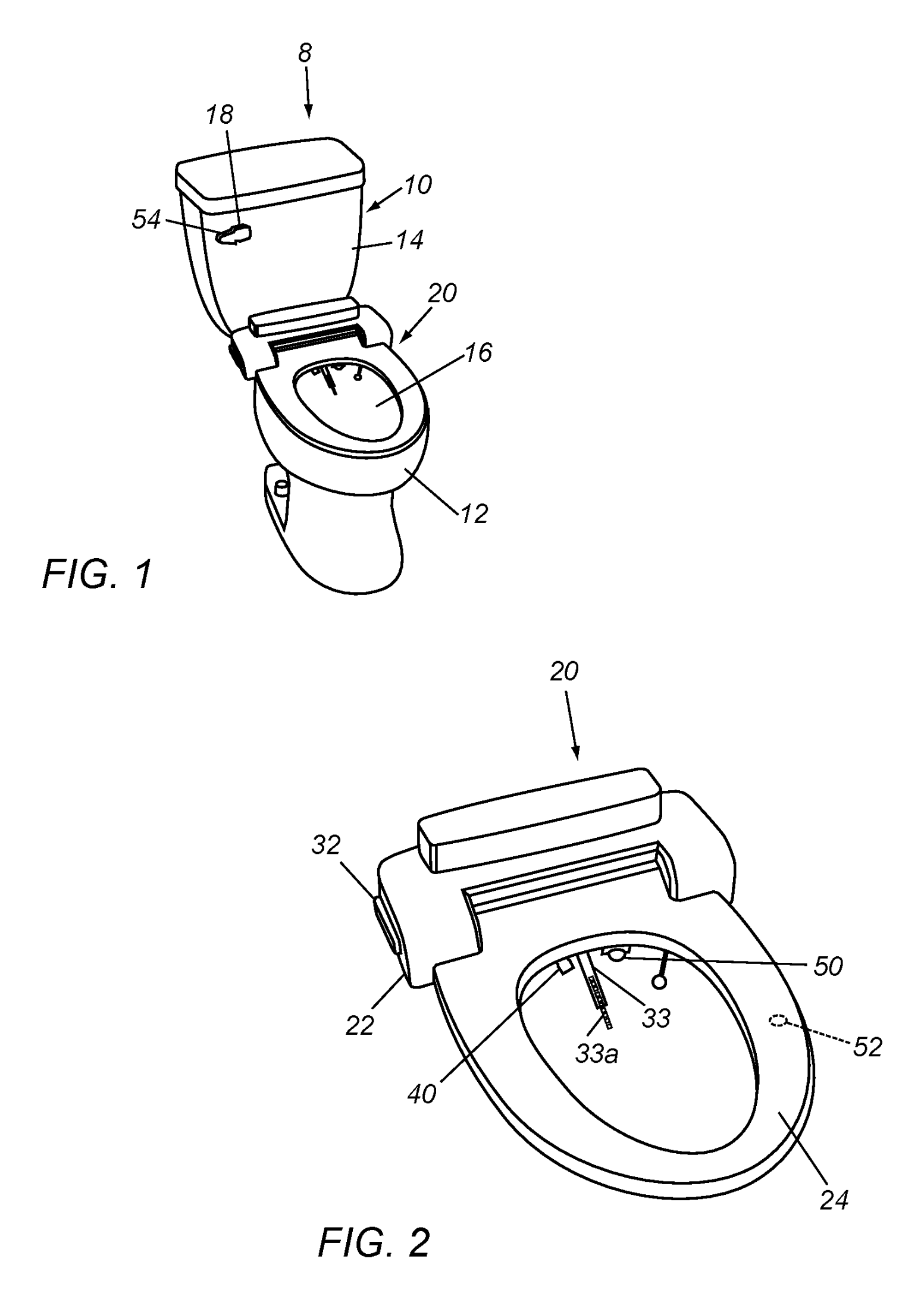
Kohler's patent treats the toilet as a platform for multiple electronically controlled features rather than a fixture with one fixed behavior. It describes variable lighting, speakers, proximity sensing, remote control, and configurable lid and seat movement.
Kohler's current Numi 2.0 also offers lighting, speakers, app and voice control, and automatic lid and seat features. No one-to-one implementation link to US20140373263A1 was verified, so the product is shown only as a related direction.
- ASSIGNEE
- Kohler Co
- PRIORITY
- 2013-01-23
- PUBLISHED
- 2014-12-25
- PUBLICATION
- US20140373263A1
- INVENTORS
- Eric M. Plate / Michael R. Bates / Fei Shen / Xue Jiongjun / Andy Zhu / Michael Cao / Li Ni
Temperature sensors search for where the urine is actually landing
What is it?
If a toilet is collecting urine for health analysis, the stream will not always strike the same point. This patent scans temperature and looks for a warmer region to estimate where fresh urine is landing.
The aim is to obtain a new sample while reducing contamination from material already on the bowl surface. Instead of asking the user to aim at a fixed collector, the toilet tries to find the sample.
- ASSIGNEE
- Shanghai Kohler Electronics Ltd
- PRIORITY
- 2016-04-28
- PUBLISHED
- 2022-06-09
- PUBLICATION
- US20220178129A1
- INVENTORS
- Zhiyu Qin / Qintao Sun
The urine-testing equipment moves into the toilet seat itself
What is it?
The patent integrates a urine collection system and analyzer with the seat assembly. The collected sample can be tested in the fixture and turned into health data.
It also describes associating health output with identification data such as a fingerprint. In a shared household, the system is designed to keep measurements attached to the correct person.
- ASSIGNEE
- Kohler Co
- PRIORITY
- 2018-05-31
- PUBLISHED
- 2024-06-06
- PUBLICATION
- US20240183841A1
- INVENTORS
- Luncheak Tan / Chinghua Chen
Cameras watch the bowl, and the patent also proposes identifying who used it
What is it?
Stanford University's patent describes cameras that can observe urine flow and stool, with analysis that can estimate urine flow and classify stool. A fingerprint reader can also be integrated with the flushing interaction.
The disclosure goes further: an upward-facing camera may acquire images of the user's anus to create an 'anal print' and compare that identity with a fingerprint. It is an extreme example of solving the problem of assigning automatically collected health data to the correct user.
- ASSIGNEE
- The Board of Trustees of the Leland Stanford Junior University
- PRIORITY
- 2018-07-09
- PUBLISHED
- 2023-03-14
- PUBLICATION
- US11604177B1
- INVENTORS
- Seung-Min Park / Daeyoun Won / Brian J. Lee / Sunil Bodapati / Alexander Lozano / Diego Escobedo / Sanjiv Sam Gambhir
Close the lid and the whole bowl becomes a sealed analysis and washing chamber
What is it?
This patent uses a lid that can seal the toilet bowl into a closed chamber. Analytical hardware can operate inside, and fluid outlets can wash the bowl and internal components afterward.
Once a toilet becomes a laboratory-like instrument, resetting it between measurements matters as much as sensing. The design treats the whole fixture as a chamber that can analyze and then clean itself for the next use.
- ASSIGNEE
- Medic Inc / Guardian Health Inc
- PRIORITY
- 2019-06-17
- PUBLISHED
- 2021-03-18
- PUBLICATION
- US20210079638A1
- INVENTORS
- David R. Hall / David Crismon / Joshua Larsen / Jared Reynolds
It estimates full body weight from the load on the seat
What is it?
A toilet is a difficult scale because some of the user's weight remains on the floor through the feet. TOTO's patent measures the load carried by the seat and calibrates it against the user's known total weight.
Later measurements can estimate total body weight from the seated load alone. The idea turns weighing from a separate task into something that can happen during a routine bathroom visit.
- ASSIGNEE
- Toto Ltd
- PRIORITY
- 2018-03-23
- PUBLISHED
- 2019-09-26
- PUBLICATION
- US20190290079A1
- INVENTORS
- Takeshi Takaki / Hiroshi Tsuboi / Hitoaki Higuchi / Koji Sonoda / Keisuke Tashiro / Tomohiro Hara / Yo Morotomi
A small cleaning unit travels around the toilet-seat ring
What is it?
Rather than rotating the entire seat, this patent moves the cleaning device around the seat. The mobile unit can carry a sponge, brush, or wiper and is driven hydraulically.
The result looks less like a self-cleaning material and more like a tiny dedicated machine that patrols one fixed surface after use.
- ASSIGNEE
- Ille Papier Service GmbH
- PRIORITY
- 2000-12-23
- PUBLISHED
- 2004-03-04
- PUBLICATION
- US20040040075A1
- INVENTORS
- Wilhelm Blatz / Michael Lenhard / Andreas Heub-Schneider
Fold it flat as a box; open it as a stool; uncover the center and it becomes a toilet
What is it?
This invention uses folding side panels to create a lightweight box-like structure. A bag can sit inside, while a hinged panel can expose or cover the central opening.
The folding structure turns the toilet into portable furniture. The same object can be packed, carried, sat on, used as a surface, or opened for sanitation.
- ASSIGNEE
- Individual
- PRIORITY
- 2008-09-05
- PUBLISHED
- 2010-03-11
- PUBLICATION
- US20100058527A1
- INVENTORS
- David W. Richardson
The toilet changes height and angle to fit the person
What is it?
The toilet is built around an internal frame with motorized lift mechanisms that can change the position of the seat or bowl. Sensors and stored preferences can be used to determine a suitable motion for an individual user.
Instead of adding an external lift or step around a fixed toilet, the fixture itself becomes the assistive device. One toilet can adapt for shorter users, taller users, children, or people who need more support while standing.
- ASSIGNEE
- Medic Inc / Guardian Health Inc
- PRIORITY
- 2019-06-17
- PUBLISHED
- 2020-12-17
- PUBLICATION
- US20200390297A1
- INVENTORS
- David R. Hall / David Crismon
AFTER THE FIGURES
The toilet is becoming one of the easiest places in the home to measure something every day
Once sensors enter the fixture, a comfort product quickly becomes a measurement device. The toilet can detect a person, locate a urine stream, analyze a sample inside the seat, connect measurements to identity, and observe waste without asking the user to perform a separate test.
A small cleaning unit travels around the seat. A folding box becomes a toilet only when needed. A motorized frame changes height and angle for the person sitting down or standing up. Hygiene, portability, and accessibility push the same object in different directions.
Across these nine patents, what happens in the toilet changes more than the outer shape of the bowl. A fixture for disposing of waste becomes a configurable appliance, a sensing station, a self-cleaning machine, and in some cases furniture that physically adapts to its user.
SOURCES
Primary sources
- US20140373263A1 — Smart toilet systems and methods
- US20220178129A1 — Smart toilet with automatic urine position detecting system
- US20240183841A1 — Health seat for toilets and bidets
- US11604177B1 — Smart toilet for human health monitoring
- US20210079638A1 — Toilet with lid for sealing bowl for analysis and washing
- US20190290079A1 — Toilet seat device
- US20040040075A1 — Device for cleaning a toilet seat
- US20100058527A1 — Portable Toilet, Stool and Table
- US20200390297A1 — Toilet with Personalized Lifting System