Cooking, shaping, personalizing nutrients, choosing a dish, tasting it, smelling it, moving it to the mouth, measuring how much was eaten and carrying the finished meal to the table can all be separated into individual technical problems. These patent drawings trace that process through the meal.
Once that happens, the meal begins to look less like one object and more like a programmable pipeline. A robot flips the burger. A printer builds food layer by layer. Diagnostic measurements feed a nutrition dispenser. A menu appears directly on the table through AR. The proposals aim to evoke taste with electrical signals, release scent from cartridges, and turn utensils and plates into sensors.
For these ten, From Patents has not verified a one-to-one primary-source link between the specific patent publication and a commercial product. FIG.05 and FIG.09 are nevertheless marked related because other companies publicly sell products that perform closely related functions; that does not mean those products implement these patents.
Put a robot arm beside the cook and let it flip the burger
What is it?
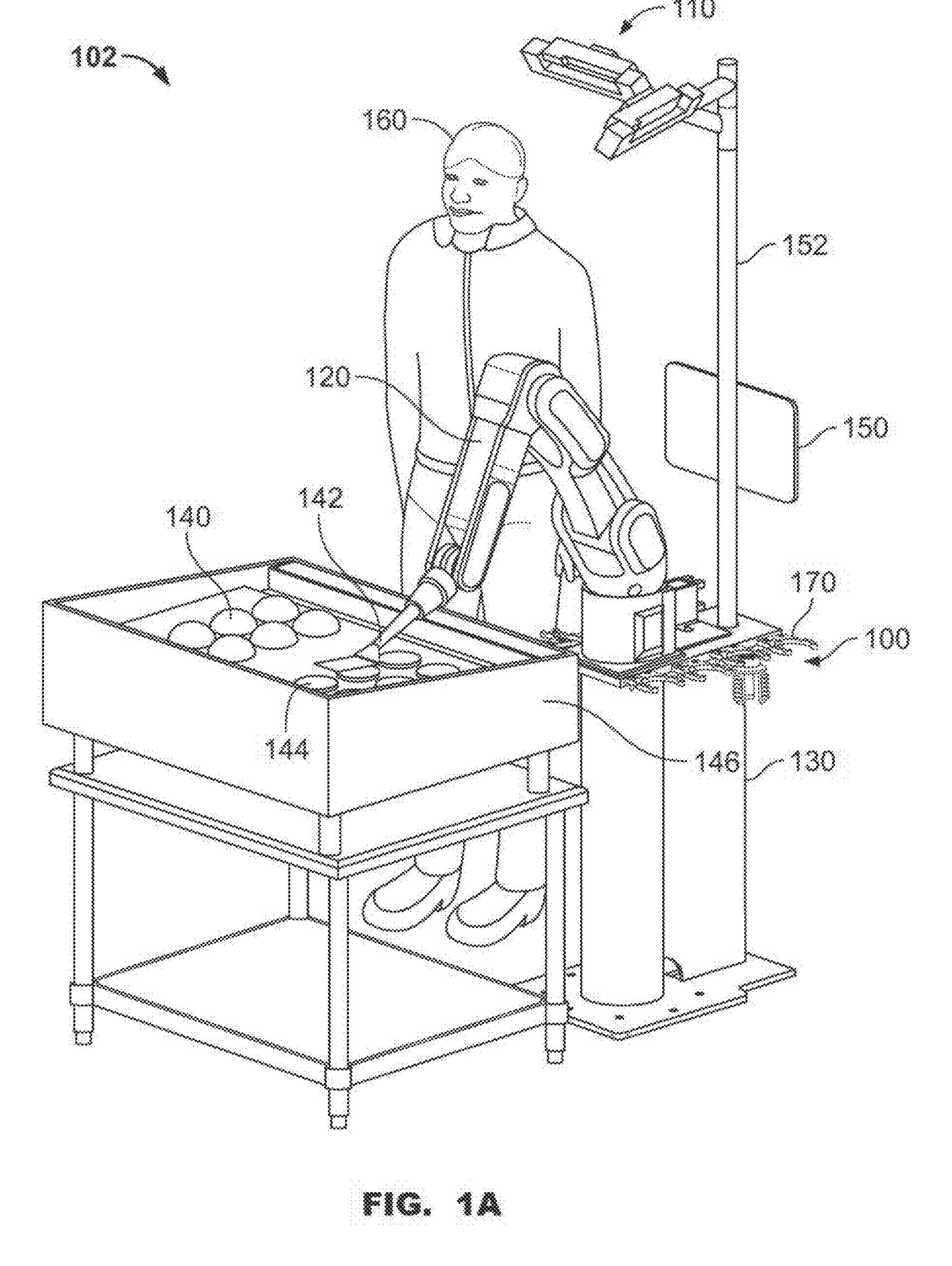
Miso Robotics' patent describes an automated kitchen assistant that observes a food-preparation area with cameras or other sensors, identifies food and kitchen objects, and can assist a human worker. In FIG. 1A, a robotic arm stands beside the worker and moves a spatula to flip a burger on the grill.
The important detail is that the machine is not sealed inside a special vending appliance. It enters a kitchen already designed for people. The patent discusses a wide range of possible robotic preparation steps, from cutting and mixing to grilling and plating.
- ASSIGNEE
- Miso Robotics Inc
- PRIORITY
- 2021-06-03
- PUBLISHED
- 2022-12-08
- PUBLICATION
- US20220386807A1
- INVENTORS
- Ryan W. Sinnet / Robert Anderson
Print the shape of the food layer by layer instead of cooking it into shape
What is it?
The 3d food printer patent describes a machine that builds three-dimensional food products by depositing edible material. FIG. 1 combines the print head, cooling system, conveying system and supporting frame in one machine. The patent uses chocolate as its main example, heating the material for extrusion and then laying down successive cross-sections.
The recipe is no longer only a sequence of ingredients, temperatures and times. Shape itself becomes data. The patent also notes that materials other than chocolate can be used, including flour, jelly powder and cream.
- ASSIGNEE
- Shanghai Fochif Electromechanical Technology Co Ltd
- PRIORITY
- 2016-04-14
- PUBLISHED
- 2017-10-19
- PUBLICATION
- US20170295816A1
- INVENTORS
- YunGan Wang / Tong Chen / Xuan Wang / Wengao Hu / Yulin Zhao / Hao Yin
Use a diagnostic sample to decide what nutrients the machine should dispense
What is it?
A Nestlé-related patent describes a system for producing a nutritional composition whose nutrient content is tailored to an individual. FIG. 1 connects a diagnostic measurement device to a controller and then to a nutritional dispenser.
The patent gives blood, urine and other samples as diagnostic inputs and proposes using the measurements to calculate a composition. The diagram labels the controller output as required micronutrient intake; this is a proposed calculation, not evidence that the system correctly establishes an individual’s nutritional needs or delivers a health benefit.
- ASSIGNEE
- Societe des Produits Nestle SA
- PRIORITY
- 2014-05-21
- PUBLISHED
- 2017-06-08
- PUBLICATION
- US20170156386A1
- INVENTORS
- Edward Baetge / Nicolas Bouche / Serge Andre Dominique Rezzi
Put the meal on the table in AR before anyone cooks it
What is it?
The Augmented reality menu patent uses a portable device camera to view the table and overlays selected dishes into that scene. In FIG. 1, the table and guest are physically present, while the plates shown on the device screen are virtual.
Instead of relying on a menu name or a flat photograph, the diner can preview what the dish would look like in front of them. The patent also describes proceeding from that augmented view into an ordering action.
- ASSIGNEE
- Individual
- PRIORITY
- 2021-11-18
- PUBLISHED
- 2022-09-06
- PUBLICATION
- US11436666B1
- INVENTORS
- Enzo Dalmazzo
Create taste with electrical signals on the tongue
What is it?
Philips' patent attempts to simulate taste without relying on the usual chemical route. FIGS. 3A and 3B detail stimulation-node arrangements used in a tongue plate. Electrical signals are applied through those nodes to stimulate sensory nerve fibers in the tongue.
The patent proposes simulating sensations such as sweet, sour, salty and bitter, and discusses synchronizing stimulation with media content. These electrode diagrams describe a proposed arrangement; they are not experimental evidence that it reproduced those tastes. The idea is to treat taste as an output separate from the food itself.
- ASSIGNEE
- Koninklijke Philips NV
- PRIORITY
- 2004-01-27
- PUBLISHED
- 2008-09-25
- PUBLICATION
- US20080234604A1
- INVENTORS
- Tom Burgmans
Turn smell into a cartridge-based display
What is it?
Aromajoin's "Aroma display" uses multiple replaceable aroma cartridges and individual air-feeding mechanisms. FIG. 2 exposes the internal architecture, with the circular housing opened to show how many scent sources and flow components fit into one device.
The patent describes selecting among cartridges and guiding scented air toward a central opening. Different scents, including examples such as coffee or mint, can therefore behave more like selectable media channels than incidental smells.
- ASSIGNEE
- Aromajoin Corp
- PRIORITY
- 2019-11-12
- PUBLISHED
- 2022-03-29
- PUBLICATION
- US11285235B2
- INVENTORS
- Kazuhiro Nakano / Quang Van Nguyen / Dong Wook Kim
Let the spoon identify what is about to enter your mouth
What is it?
The Smart Watch and Food Utensil for Monitoring Food Consumption patent combines a sensor-equipped utensil with a wearable monitor. FIGS. 1 through 4 show a smart spoon containing a chemical composition sensor, processing and communications hardware, together with a wrist-based device.
The patent describes identifying foods, ingredients or nutrients through chemical or optical analysis and sending that information to a smart watch or another location. Instead of asking the user to log a meal afterward, the system tries to collect information during the act of eating.
- ASSIGNEE
- Medibotics LLC
- PRIORITY
- 2013-05-23
- PUBLISHED
- 2014-11-27
- PUBLICATION
- US20140349257A1
- INVENTORS
- Robert A. Connor
Let the plate measure how much food disappears, plus salinity and temperature
What is it?
ETRI's "Meal plate for guiding correct eating habits and adjusting amount of meal" turns the plate itself into a monitoring device. FIG. 1 shows several container-receiving areas together with an input section, display, speaker and power source.
The patent describes sensors that can measure food weight, salinity and temperature, store the readings, display them and transmit them to a user terminal. The plate can therefore observe the meal changing rather than relying only on a person's later recollection.
- ASSIGNEE
- Electronics and Telecommunications Research Institute ETRI
- PRIORITY
- 2010-11-29
- PUBLISHED
- 2012-05-31
- PUBLICATION
- US20120135383A1
- INVENTORS
- YongWon Jang / Hyung Wook NOH / Inbum Lee / Yoon Seon Song / Sooyeul Lee
Put the finished dishes on a three-level robot and send them to the table
What is it?
RGT's "Restaurant service robot" includes multiple tray seating units, a controller, a driving unit and an output mechanism for delivering food to a target table. FIG. 1 shows a robot with three trays arranged vertically.
Cooking is not the final step of a restaurant meal. The food still has to travel from kitchen to guest. This patent treats that short physical journey as another task that can be separated from human labor and assigned to a mobile machine.
- ASSIGNEE
- Rgt Inc
- PRIORITY
- 2020-07-22
- PUBLISHED
- 2023-03-30
- PUBLICATION
- US20230095636A1
- INVENTORS
- Ho Jeong JEONG
Build the bar itself around giant robot arms that mix the drink
What is it?
The Interactive robotic station for beverage, in particular cocktail, preparation and dispensing patent describes an automated beverage station driven by user input and large industrial robots. FIG. 2 is an exploded view of a robotic station that brings the arms, supply components and working area together into one system.
The proposal turns the bartender's sequence of reaching, mixing and serving into coordinated robot motion. Where the first patent in this article gave a machine one cooking task beside a human, this final patent makes the machinery itself part of the bar's architecture.
- ASSIGNEE
- Individual
- PRIORITY
- 2013-04-09
- PUBLISHED
- 2016-02-25
- PUBLICATION
- US20160052770A1
- INVENTORS
- Carlo Filippo Ratti
AFTER THE FIGURES
The future meal may depend less on a single food invention than on programming each step around it
Seen together, these patents divide the meal into technical steps. One machine cooks, another prints shape, another changes nutrient composition, and AR changes how the choice is made. Taste, smell, utensils, plates and delivery all become separate layers that can be measured or controlled.
The most unusual shift is that eating itself becomes both an input and an output. The tongue becomes an electrical interface, scent becomes a display channel, a spoon reads the food, and a plate measures the meal as food is eaten. The experience of eating is treated almost like a system with sensors, actuators and data flowing in both directions.
Many small automations could therefore transform the future table. Decisions and sensations that people currently perform without thinking are decomposed into measurable steps. Put enough of those steps together, and the meaning of a meal starts to change.
SOURCES
Primary sources
- US20220386807A1 — Automated kitchen system for assisting human worker prepare food
- US20170295816A1 — 3d food printer
- US20170156386A1 — System, process and device for producing a nutritional composition with personalized nutrient content
- US11436666B1 — Augmented reality menu
- US20080234604A1 — Method and Apparatus For Simulating Taste Sensations in a Taste Simulation System
- US11285235B2 — Aroma display
- US20140349257A1 — Smart Watch and Food Utensil for Monitoring Food Consumption
- US20120135383A1 — Meal plate for guiding correct eating habits and adjusting amount of meal
- US20230095636A1 — Restaurant service robot
- US20160052770A1 — Interactive robotic station for beverage, in particular cocktail, preparation and dispensing