When we imagine the future, we often think about things outside ourselves: new vehicles, new devices, new buildings. Public patents tell a different story as well. Some of the strangest ideas head inward, toward the body itself. You wear a chair on your legs, grow extra arms from your back, add a sixth finger to the hand, or place a display directly on the eye. The tool of the future is not only something you hold. It increasingly becomes something you wear, attach, or let move with your body.
Some inventions aim to reduce fatigue during standing work, ease the strain of leaning forward, tighten a shoe automatically or inflate to protect the body during a fall. Others try to add new senses, such as returning touch through a glove or reading chemical information through a skin-mounted sensor. The body is treated less like a fixed biological given and more like a platform that can be upgraded in pieces.
Most of these proposals remain public patent ideas whose implementation in commercial products is unverified. Nike's auto-lacing footwear offers a close public example, but one-to-one patent marking for the exact publication remains unconfirmed.
Wear a chair on your legs so you can sit while standing
What is it?
"Chairless chair exoskeleton" is a wearable seat for long periods of standing work. In FIG. 1, thigh supports, calf supports, a foot connection, a joint and an energy-storage element are arranged along the back of the leg, showing how a semi-seated posture can be created without carrying a conventional seat surface.
Because the user is still expected to move through the workspace, this is not just a folding stool. It is a support mechanism meant to travel with the body like part of the body. Instead of placing furniture in the environment, the patent pulls the function of furniture onto the wearer.
- ASSIGNEE
- Ozyegin Universitesi
- PRIORITY
- 2020-12-30
- PUBLISHED
- 2023-07-27
- PUBLICATION
- US20230234214A1
- INVENTORS
- Ramazan Unal / Ozgur Karaoglan
Add extra robotic arms to your back for manual work
What is it?
MIT's "Wearable Robot Assisting Manual Tasks" is a patent for supernumerary wearable arms. In FIG. 1, a frame worn on the body supports multiple robotic arms that extend forward into the task space.
The important shift is that the invention does not merely assist the hand. It gives the person another pair of arms. If holding, bracing and auxiliary motions can be offloaded to those arms, tasks that normally require more than one person may become manageable by one wearer.
- ASSIGNEE
- Massachusetts Institute of Technology
- PRIORITY
- 2014-01-13
- PUBLISHED
- 2015-08-06
- PUBLICATION
- US20150217444A1
- INVENTORS
- Haruhiko Harry Asada / Baldin Adolfo Llorens-Bonilla
Give the body extra support limbs for difficult postures
What is it?
"Robotic systems for supporting a user" focuses on posture support and load sharing. In FIG. 1, a frame worn around the user supports extra limb-like members that help stabilize leaning or crouched working positions.
The system is not trying to replace walking with a full robot body. Instead, it transfers support for particular postures to the added limbs. The wearer keeps moving naturally, while a third or fourth leg appears only when needed to reduce strain.
- ASSIGNEE
- Massachusetts Institute of Technology
- PRIORITY
- 2016-03-10
- PUBLISHED
- 2017-09-14
- PUBLICATION
- US20170259427A1
- INVENTORS
- Haruhiko Harry Asada / Daniel A. Kurek
Add a sixth finger to create new ways of gripping
What is it?
"A device for enhancing a subject's grasping capability" is essentially a sixth-finger patent. In FIG. 1, an auxiliary finger is worn on the hand or forearm and curves around the object from outside the normal five-finger arrangement.
What makes it compelling is that it does not only replace lost function. It adds a new grasping path to an already capable hand. By increasing the number of opposing contact points, it can broaden the range of stable grips available to the user.
- ASSIGNEE
- Universita degli Studi di Siena
- PRIORITY
- 2016-02-09
- PUBLISHED
- 2021-02-25
- PUBLICATION
- US20210052399A1
- INVENTORS
- David Cioncoloni / Irfan Hussain / Domenico Prattichizzo / Simone Rossi / Gionata Salvietti / Giovanni Spagnoletti
Use ultrasound to create a body sensation without touching that body part
What is it?
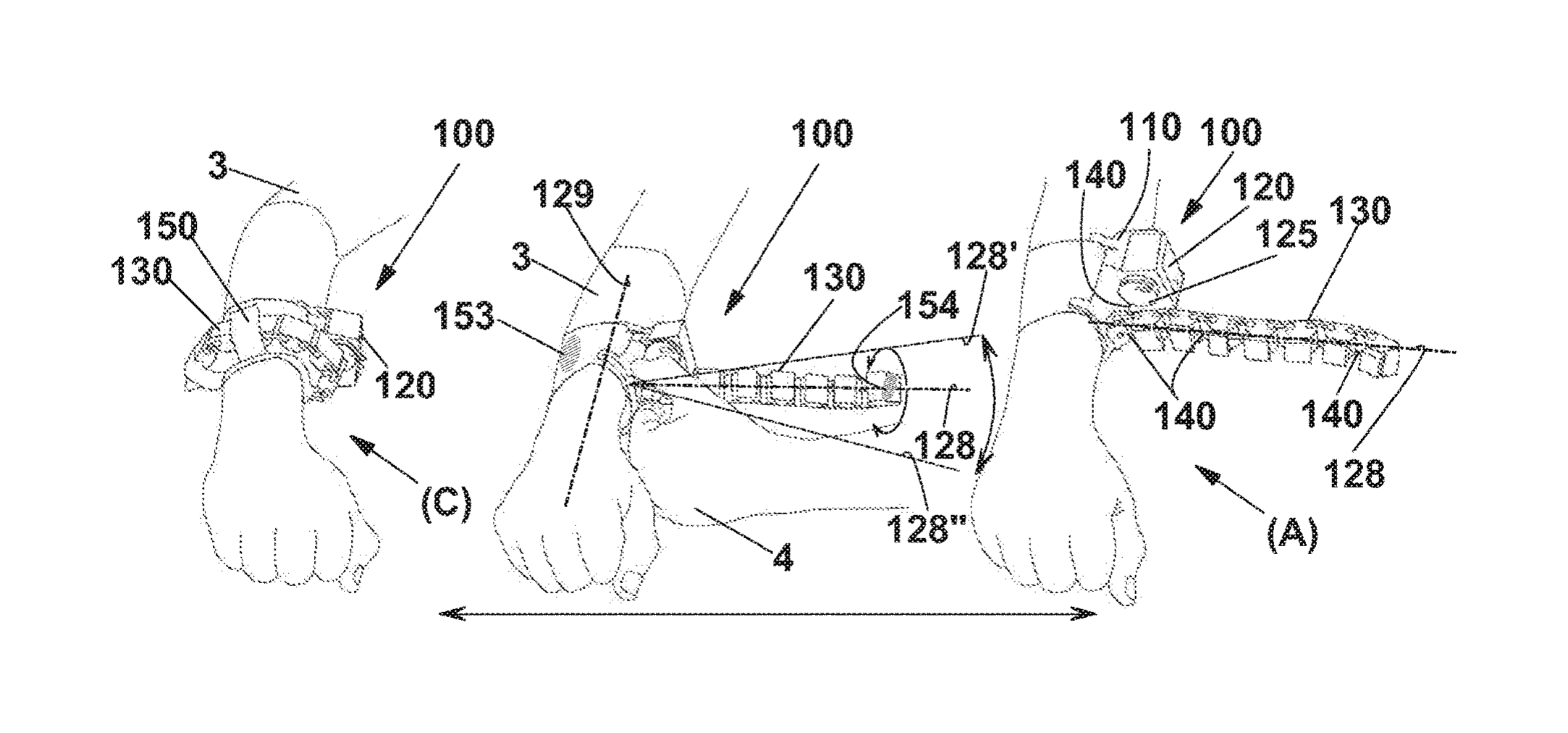
Samsung Electronics' "Electronic device, wearable device, and method of providing content-based somatic senses using ultrasound" explores a different route to haptics. FIG. 1 shows a user consuming content while wearing a device near the head, with a sensation represented at the foot.
The patent describes generating an ultrasound driving signal from somatosensory data associated with content and using it to stimulate a particular region of the brain. Instead of putting an actuator on every body part that should feel something, the system tries to control where and what the user feels through the head-mounted device.
- ASSIGNEE
- Samsung Electronics Co Ltd
- PRIORITY
- 2016-11-14
- PUBLISHED
- 2018-05-17
- PUBLICATION
- US20180135001A1
- INVENTORS
- Seung-ryong Jeon / Ki-Hyun Kim / Taek-Soo Kim / Eun-Jung Lee / Gyeong-cheol Jang
Let the shoe tighten itself instead of asking the wearer to tie it
What is it?
Nike's "Automated footwear lacing systems, devices, and techniques" aims to automate shoe fit. In FIG. 1, internal wrapping and actuation structures are integrated into the footwear so the shoe can tighten or adjust around the foot.
The footwear responds as a system. Clothing and machine move closer together, and even a familiar action like tying laces becomes something the product can take over.
- ASSIGNEE
- Nike Inc
- PRIORITY
- 2017-05-31
- PUBLISHED
- 2023-11-23
- PUBLICATION
- US20230371653A1
- INVENTORS
- Steve Gaynes / David Mellinger
Return the feel of virtual objects through a glove
What is it?
"Haptic actuators and related wearable devices" is a patent for thin touch-feedback devices worn close to the body. In FIG. 1, multiple actuators are arranged on a wearable structure that follows the hand and fingers.
The important shift is that the invention is not mainly an input device. It is an output device for the skin. Instead of only seeing and hearing virtual objects, the wearer could receive localized tactile signals that make the digital world feel physically present.
- ASSIGNEE
- Meta Platforms Technologies LLC
- PRIORITY
- 2021-05-10
- PUBLISHED
- 2024-05-23
- PUBLICATION
- US20240168557A1
- INVENTORS
- DongSuk Shin / Benjamin Gorissen / Daniele Piazza / David Rother Dobbs / Erik Samuel Roby
Turn the contact lens itself into a display
What is it?
Samsung Display's "Display panel and smart contact lens including the display panel" describes a smart contact lens. In FIG. 3, the lens, display panel and surrounding structural elements are separated in an exploded view that makes the embedded display architecture visible.
This is even closer to the body than a smartwatch or smart glasses. Instead of glancing at something in the hand or in front of the face, the display function is moved directly onto the eye, stacking information onto the visual field itself.
- ASSIGNEE
- Samsung Display Co Ltd
- PRIORITY
- 2021-02-22
- PUBLISHED
- 2022-08-25
- PUBLICATION
- US20220269109A1
- INVENTORS
- Junghun Lee / Jiheon Lee
Read chemistry from the body using a sensor attached to the skin
What is it?
"Wearable electrochemical sensors" covers thin sensors that can be attached to the skin. The FIG. 5C image used here combines images of a skin-mounted device with electrochemical measurement results, making the intended sensing role easy to understand.
This is less like a watch and more like turning the skin itself into a measurement surface. Without directly looking inside the body, the device seeks to estimate body state through sweat and other near-surface chemistry.
- ASSIGNEE
- University of California Berkeley; University of California San Diego UCSD
- PRIORITY
- 2012-05-10
- PUBLISHED
- 2018-08-09
- PUBLICATION
- US20180220967A1
- INVENTORS
- Joseph Wang / Joshua Ray Windmiller / Amay Jairaj Bandodkar
Protect the body with a wearable airbag that inflates only when needed
What is it?
"Wearable airbag device" describes an airbag worn by the person rather than hidden inside a vehicle. The figure shows a body-mounted structure surrounding the shoulders and chest, intended to deploy during a fall or impact.
Protective gear is often passive, like a helmet or hard pad. This concept is different because it changes state only at the critical moment. Most of the time it tries to stay unobtrusive, then briefly adds a protective structure around the body when danger appears.
- ASSIGNEE
- Toyoda Gosei Co Ltd
- PRIORITY
- 2021-03-17
- PUBLISHED
- 2022-09-22
- PUBLICATION
- US20220295918A1
- INVENTORS
- Toshihito Yanagisawa / Wataru Miura / Yusuke Kawamura
AFTER THE FIGURES
The future body is less about holding machines and more about machines moving closer to the body
These ten patents turn chairs, fingers, ultrasound, shoes, lenses, sensors and airbags into body-adjacent systems. Instead of sitting outside the user as separate machines, they act directly on posture, sensation, motion and protection.
What is striking is how broad the meaning of augmentation becomes. One idea adds robotic arms for manual work. Another adds support limbs for uncomfortable postures. One device returns touch in virtual interaction, while another reads chemistry from the skin. These patents often add just one missing function at a specific place.
In that version of the future, the line between human and tool gets harder to see. Shoes tighten themselves, skin becomes a sensor, a lens becomes a display, and extra limbs appear when useful. The body starts to look less like a finished object and more like an interface that can accept removable modules.
SOURCES
Primary sources
- US20230234214A1 — Chairless chair exoskeleton
- US20150217444A1 — Wearable Robot Assisting Manual Tasks
- US20170259427A1 — Robotic systems for supporting a user
- US20210052399A1 — A device for enhancing a subject's grasping capability
- US20180135001A1 — Electronic device, wearable device, and method of providing content-based somatic senses using ultrasound
- US20230371653A1 — Automated footwear lacing systems, devices, and techniques
- US20240168557A1 — Haptic actuators and related wearable devices
- US20220269109A1 — Display panel and smart contact lens including the display panel
- US20180220967A1 — Wearable electrochemical sensors
- US20220295918A1 — Wearable airbag device