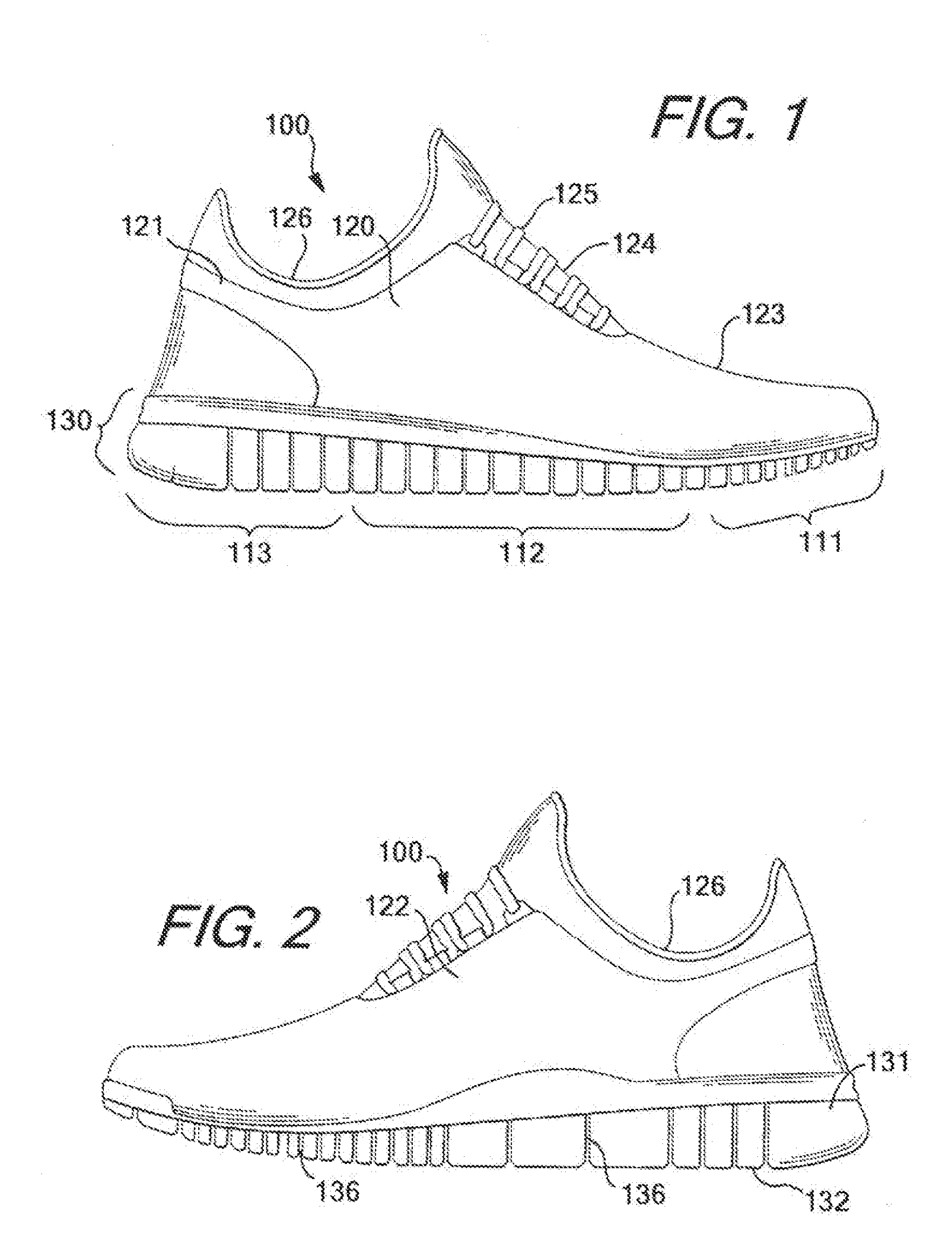
Across Nike patent drawings, shoes and apparel gradually stop behaving like passive objects. Garment textiles change structure in response to heat or moisture, while a shoe can treat foot movement as a command. Clothing measures body position and can answer with haptic feedback.
Materials and structures also respond to the body. Some ideas rely on magnets, air chambers, flexible cooling packs, or layered materials. The machinery is spread across motors, sensors, structures, fluids, and textiles.
Direct implementation in products remains unverified for all eight patents.
Heat or moisture changes the textile structure and the garment's permeability
What is it?
The patent incorporates textiles whose structure changes in response to physical stimuli including moisture, increased temperature, or moving air. Changes in openings, yarn geometry, or thickness can alter how easily air or water passes through the material.
No separate motor has to open a vent. The textile itself becomes the responsive mechanism, turning an apparently ordinary garment surface into a material system whose state can change while it is worn.
- ASSIGNEE
- Nike Inc
- PRIORITY
- 2004-03-19
- PUBLISHED
- 2005-09-22
- PUBLICATION
- US20050208860A1
- INVENTORS
- Michael Baron / Karin Carter / Bhupesh Dua
A foot gesture becomes the button that tightens the shoe
What is it?
The system uses pressure or motion sensing to distinguish a deliberate control gesture from normal movement. A prompting gesture can arm the system, after which another gesture can mean tighten, loosen, or perform another command.
The wearer does not need a separate handheld controller. The body part already inside the device becomes the input mechanism for the device itself.
- ASSIGNEE
- Nike Inc
- PRIORITY
- 2012-02-22
- PUBLISHED
- 2016-09-15
- PUBLICATION
- US20160262485A1
- INVENTORS
- Steven H. Walker
A shoe surface displays an image without becoming an electronic screen
What is it?
Here, 'display' does not mean an LCD or LED panel. The structure uses raised and recessed portions in a semi-transparent layer so that light transmission and the background layer create the visible image.
Instead of printing a graphic onto the shoe, the visual effect is built into the material geometry itself. The apparel surface becomes a display layer without conventional electronics.
- ASSIGNEE
- Nike Inc
- PRIORITY
- 2010-05-13
- PUBLISHED
- 2019-04-25
- PUBLICATION
- US20190118416A1
- INVENTORS
- James E. Diepenbrock / Connie A. Sarkinen / Todd A. Waatti
Clothing measures body position and taps the wearer with haptic guidance
What is it?
The patent describes apparel equipped with ultrasonic positioning sensors and feedback devices that can support activities such as exercise or yoga.
Instead of requiring the wearer to watch a screen, the garment can return guidance directly through touch. The same wearable becomes both the measuring system and the output device.
- ASSIGNEE
- Nike Inc
- PRIORITY
- 2015-11-30
- PUBLISHED
- 2020-10-22
- PUBLICATION
- US20200334962A1
- INVENTORS
- Ernest Kim
A magnetic fastener makes the shoe quick to secure with one hand
What is it?
The fastener does more than rely on magnetic attraction. The male portion fits into a shaped recess that constrains orientation and resists twisting once engaged.
Mechanical geometry and magnetic assistance can reduce the manual manipulation needed to secure the shoe with one hand.
- ASSIGNEE
- Nike Inc
- PRIORITY
- 2017-08-30
- PUBLISHED
- 2020-09-17
- PUBLICATION
- US20200288800A1
- INVENTORS
- Giorgio Anceresi / Eric Y. Lee
A cooling vest bends with the body instead of carrying rigid cold packs
What is it?
Conventional cooling garments can become uncomfortable when rigid ice packs pull away from the body or restrict movement. This system combines flexible cooling packs with garment structures intended to hold them against the wearer.
The garment becomes a thermal-control system, moving the role of sports apparel beyond coverage and moisture management into active body cooling.
- ASSIGNEE
- Nike Inc
- PRIORITY
- 2018-08-30
- PUBLISHED
- 2020-12-24
- PUBLICATION
- US20200397072A1
- INVENTORS
- Jacob R. Arnold / Baron C. Brandt / Alexander J. Dedman / Payton A. Rose / Kevin C. Sze
The heel and forefoot can use different air pressures inside the same sole
What is it?
A valve structure divides the air system into multiple chambers, allowing pressure in different regions of the sole to be adjusted separately.
Instead of defining cushioning entirely through a fixed foam shape, the sole can be treated as a fluid system whose state changes according to how it is inflated.
- ASSIGNEE
- Nike Inc
- PRIORITY
- 2011-04-06
- PUBLISHED
- 2025-02-20
- PUBLICATION
- US20250057288A1
- INVENTORS
- Elizabeth Langvin / James Molyneux / Lee D. Peyton / Ty A. Ransom / Nicola J. Reynolds / Aaron B. Weast
The shoe carries a heater and battery to warm the foot from inside
What is it?
The patent uses a removable inner liner that carries a heating system, wiring, and a battery compartment. A heating element is positioned around the toe-cap region.
Instead of adding more passive insulation, the footwear actively produces heat. Paired with the cooling garment elsewhere in the article, it shows apparel being designed to move body temperature in either direction.
- ASSIGNEE
- Nike Inc
- PRIORITY
- 2012-08-29
- PUBLISHED
- 2014-03-06
- PUBLICATION
- US20140059882A1
- INVENTORS
- Jaroslav J. Lupinek / Patricia L. Smaldone
AFTER THE FIGURES
Footwear and apparel move from fitting the body to reading it and responding
Across these eight patents, adaptive ventilation, tightening, display, haptics, cooling, air pressure, and active heating all move into the things worn directly on the body.
The shoe becomes especially machine-like. It can use a motor to tighten, interpret foot movement as an input, actively warm the foot, and alter pneumatic behavior under different parts of the sole. Wearing the product is no longer the end of the interaction.
Apparel, meanwhile, becomes an interface between body and environment. It can change textile permeability in response to stimuli, sense position, return tactile guidance, and move heat away from the wearer. The future sports garment looks less like passive fabric and more like a thin mechanical layer that exchanges information and energy with the body.
SOURCES
Primary sources
- US20050208860A1 — Article of apparel incorporating a modifiable textile structure
- US20160262485A1 — Motorized Shoe With Gesture Control
- US20190118416A1 — Device for displaying image on apparel
- US20200334962A1 — Apparel with ultrasonic position sensing and haptic feedback for activities
- US20200288800A1 — Magnetic fastener for an article of footwear
- US20200397072A1 — Flexible cooling garment system
- US20250057288A1 — Adjustable Multi-Bladder System For An Article Of Footwear
- US20140059882A1 — Article of Footwear with a Heating System