In Disney's patent drawings, characters leave their fixed locations, rides respond to passengers, and new surfaces become screens. The park's scenery and machinery change with the way guests move and interact.
Characters become self-balancing robots that can walk toward guests. A robot meant to be hugged grows a soft, pressure-sensing body. A drone disappears inside a pirate ship, while hundreds of other aircraft become pixels in a screen made of air. A lightsaber blade physically extends from its hilt. Then the ride vehicle itself starts to disappear: first the passenger can steer the motion, then the floor moves under the passenger, sand becomes a projection surface, and fog becomes a display you can walk around.
The ten patents below were published under Disney Enterprises. Disney has publicly shown related entertainment robotics, drone shows, an extendable lightsaber and the HoloTile floor, but we have not verified a one-to-one patent marking for the specific publications below.
Let the character walk over to the guest on two legs
What is it?
"Legged high-dexterity self-balancing capable robot actor" describes a two-legged platform intended to bring screen-bound characters into the physical world at character-appropriate scale. FIG. 9 labels perception and natural-language functions in the head, computing and balance control in the torso, an IMU in the pelvis, actuation and sensing in the limbs, and touchdown sensing in the feet.
The important word in the patent is not simply robot but actor. The same underlying mobility hardware can wear a character-specific outer skin and perform gestures, body language and show movements while maintaining balance and moving untethered through a physical space.
- ASSIGNEE
- Disney Enterprises Inc
- PRIORITY
- 2019-05-24
- PUBLISHED
- 2022-04-21
- PUBLICATION
- US20220119053A1
- INVENTORS
- Scott Christopher Lavalley / Kyle Robert Thompson / Michael Anthony Hopkins / Dexter J. Dickinson / Jared Edward Bishop / Jerry W. Rees / Kyle Michael Cesare
Make a robot soft enough to hug
What is it?
"Soft body robot for physical interaction with humans" starts from a problem that becomes unavoidable when a character is supposed to touch a person: a precise robot can still be a hard machine. FIG. 10B shows the side view of a 10-DOF upper-body prototype whose arms, chest, waist and back are wrapped in large soft modules.
Those modules use deformable, air-filled cavities connected to pressure sensing. The patent explicitly discusses hugging and other close human-robot interactions, treating the outer body both as a contact sensor and as a bumper that protects the guest and the mechanism.
- ASSIGNEE
- Disney Enterprises Inc
- PRIORITY
- 2015-10-01
- PUBLISHED
- 2017-04-06
- PUBLICATION
- US20170095925A1
- INVENTORS
- Katsu Yamane / Joohyung Kim / Alexander Nicholas Alspach
Float an animatronic eyeball in liquid and turn it with magnets
What is it?
"Animatronic Eye with an Electromagnetic Drive and Fluid Suspension and with Video Capability" replaces an obvious mechanical eye shaft with a sphere suspended inside a transparent, fluid-filled shell. FIG. 4 pulls apart the shell, inner eyeball, magnetic elements, drive components and rear optical path.
Magnetic elements in the inner sphere respond to an external electromagnetic drive, while the suspension fluid can damp fast motion and reduce the visual boundary between the pieces when its refractive properties are matched to the transparent parts. A rear camera can also look through the eye, allowing gaze motion and visual sensing to share the same physical organ.
- ASSIGNEE
- Disney Enterprises Inc
- PRIORITY
- 2009-09-16
- PUBLISHED
- 2011-03-17
- PUBLICATION
- US20110066239A1
- INVENTORS
- Lanny Starkes Smoot / Katherine May Bassett / Marcus Hammond
Hide the drone so the pirate ship appears to fly by itself
What is it?
"Themed aerial vehicle entertainment platform" treats the UAV as backstage machinery. In FIG. 2, a multi-rotor aircraft is wrapped in sailing-ship cladding designed to hide the vehicle from spectators on the ground.
The UAV moves the cladding through three-dimensional space so the themed object appears to provide its own propulsion. The patent also allows onboard show effects to respond to flight state, for example by changing an engine-glow effect with vehicle speed, so flight control and theatrical performance can be coordinated in real time.
- ASSIGNEE
- Disney Enterprises Inc
- PRIORITY
- 2019-07-26
- PUBLISHED
- 2021-01-28
- PUBLICATION
- US20210027638A1
- INVENTORS
- Pehr L. Hovey / Loyal J. Pyczynski / Madeline R. Zupan
Turn hundreds of aircraft into pixels in the sky
What is it?
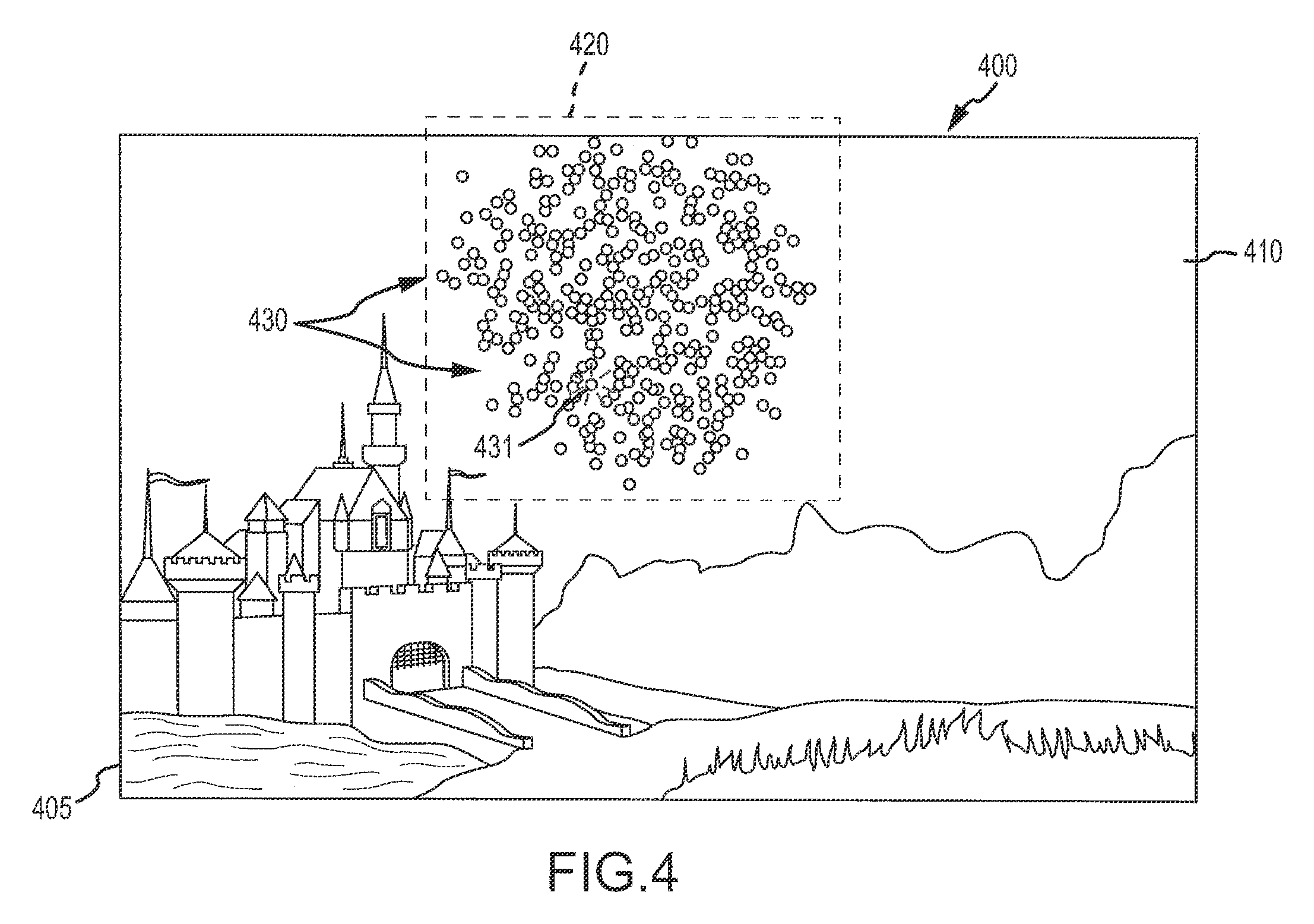
"Aerial display system with floating pixels" reduces each small UAV to one display element. The patent calls it a floating pixel, or flixel, and arranges many flixels in three-dimensional airspace to create a very large aerial display.
FIG. 4 shows a dense field of those points above a castle. Because every pixel can fly, the system can change the size and shape of the display space itself rather than being confined to a permanent rectangular screen.
- ASSIGNEE
- Disney Enterprises Inc
- PRIORITY
- 2013-02-15
- PUBLISHED
- 2014-08-21
- PUBLICATION
- US20140236388A1
- INVENTORS
- Clifford Wong / James Alexander Stark / Robert Scott Trowbridge
Make the glowing lightsaber blade physically extend from the hilt
What is it?
"Sword device with retractable, internally illuminated blade" tackles an effect that is easy in a movie and difficult in front of a live audience: a bright energy blade that visibly grows from a handheld hilt. FIG. 2 removes the outer sidewalls to expose the two blade spools, blade form, motor, drive train and LED spool.
In storage, the flexible blade-body members and light strip are reeled into the hilt. When activated, they are fed through the form so the two body members become an elongated blade with the LEDs between them. The result is a physical prop that can imitate the extend-and-retract effect without relying on post-production.
- ASSIGNEE
- Disney Enterprises Inc
- PRIORITY
- 2017-03-16
- PUBLISHED
- 2018-11-15
- PUBLICATION
- US20180326317A1
- INVENTORS
- Michael R. Honeck / Lanny S. Smoot / Quinn Y. Smithwick / Eli Joseph Romaire / David J. McCall / Terry O. Sandin / Adam B. Forster / Peter Anastasios Chevako
Let the rider's body and controls change the motion of the ride
What is it?
"Rider controlled amusement park ride" moves beyond a vehicle that simply delivers a pre-programmed sequence. FIG. 2 shows an overhead track module, a multi-jointed motion arm and a passenger vehicle themed like a hang glider.
The input does not have to be a conventional joystick. The patent describes detecting a passenger shifting weight, applying force to a bar or handle, or changing the position of an input device, then using that signal to alter the vehicle's motion or orientation.
- ASSIGNEE
- Disney Enterprises Inc
- PRIORITY
- 2023-06-12
- PUBLISHED
- 2024-12-12
- PUBLICATION
- US20240408503A1
- INVENTORS
- Robert J. Evans
Remove the ride vehicle and move the floor instead
What is it?
"Modular omnidirectional actuated floors providing an interactive user experience" turns the ground into the motion system. FIG. 1 shows two people and an object standing on a surface assembled from many active tiles.
Sensors can determine a user's position and orientation, while the tiles move underfoot. If a person walks one way, the floor can move the other way to keep the person inside its boundary. The patent also describes simulating slipping, uneven terrain and other physical feedback, as well as moving props around the user.
- ASSIGNEE
- Disney Enterprises Inc
- PRIORITY
- 2023-10-05
- PUBLISHED
- 2025-04-10
- PUBLICATION
- US20250117069A1
- INVENTORS
- Jack Wetherell / Robert J. Bristow / Lanny S. Smoot / Alfredo M. Ayala / Michael Ryan Enriquez Arevalo / Frank D. Mezzatesta, III
Turn a sandbox into a screen whose shape the guest can rebuild by hand
What is it?
"Interactive Projected Sandbox" makes the sand both interface and display. FIG. 11 brings the tangible material, an overhead projector, a computer and display, and the user’s hand into one system.
The experience can first project guides telling the user where to remove or pile material. Once a three-dimensional form has been sculpted, mapped still images or video can be projected onto it. The patent gives a volcano with animated lava flowing over the user-made terrain as one example.
- ASSIGNEE
- Disney Enterprises Inc
- PRIORITY
- 2009-07-17
- PUBLISHED
- 2012-05-31
- PUBLICATION
- US20120133911A1
- INVENTORS
- Thomas Fraiser Laduke
Cross sheets of fog to make an image you can walk around
What is it?
"System for generating a 360 degree viewable image on laminar fog screen" replaces a solid screen with thin flows of water droplets. FIG. 2 arranges four laminar fog surfaces in an X and places four light sources or projectors around them.
Each projector can show a different side of the same item (front, back, left or right) on its respective fog surface. Because the fog acts as a highly directional projection surface, a guest moving around the installation can see the view appropriate to the angle, creating the impression of a floating image that can be viewed from multiple sides.
- ASSIGNEE
- Disney Enterprises Inc
- PRIORITY
- 2023-11-08
- PUBLISHED
- 2025-05-08
- PUBLICATION
- US20250147401A1
- INVENTORS
- Daniel M. Joseph / Jessica Klouda
AFTER THE FIGURES
In these patents, the theme park stops being a collection of fixed stages
Across the ten drawings, different parts of the stage become active. Characters leave their pedestals. The sky becomes a display surface. A prop performs an effect that used to exist only in post-production. The guest's vehicle, the floor beneath it, the sand under a hand and even a sheet of water droplets can all become active parts of the story.
These inventions pursue immersion through physical changes. Soften the robot so a person can touch it. Hide the UAV so the themed object appears to fly by itself. Move the ground in the opposite direction of a walking guest. Project onto fog instead of a wall. The machinery is still there, but the patent keeps pushing it out of the guest's attention.
In that version of the future, the distinction between stage, character, vehicle, interface and screen becomes harder to see. The whole environment starts to behave like one large piece of show machinery.
SOURCES
Primary sources
- US20220119053A1 — Legged high-dexterity self-balancing capable robot actor
- US20170095925A1 — Soft body robot for physical interaction with humans
- US20110066239A1 — Animatronic Eye with an Electromagnetic Drive and Fluid Suspension and with Video Capability
- US20210027638A1 — Themed aerial vehicle entertainment platform for providing dynamically-coordinated show
- US20140236388A1 — Aerial display system with floating pixels
- US20180326317A1 — Sword device with retractable, internally illuminated blade
- US20240408503A1 — Rider controlled amusement park ride
- US20250117069A1 — Modular omnidirectional actuated floors providing an interactive user experience
- US20120133911A1 — Interactive Projected Sandbox
- US20250147401A1 — System for generating a 360 degree viewable image on laminar fog screen